
Article: How to Choose a Signature Scent for the Office
How to Choose a Signature Scent for the Office
Table of Contents
- How to Find Your Signature Scent Before You Bring It to Work
- Start With Fragrance Families, Not Specific Bottles
- Read the Notes and Watch the Dry-Down
- Test on Skin, Not Paper or Clothing
- The Best Scent for an Office Is the One Nobody Has to Notice
- How Many Sprays of Perfume to Wear at Work
- How Long Does Perfume Last, and How to Keep It Discreet All Day
- Match the Scent to Your Office Environment
- A Two-Week Office Scent-Testing Protocol
- Conclusion
- Frequently Asked Questions
Last Updated: October 8, 2026
How to Find Your Signature Scent Before You Bring It to Work
Choosing a signature scent for the office starts with learning what your nose likes, then testing slowly on your own skin.
The best office scent is not the boldest one you own, it stays close to your skin and never overwhelms a shared room.
American Academy of Dermatology guidance on skin and product reactions
Start With Fragrance Families, Not Specific Bottles
Most people shop backward: they smell a bottle, like it, and buy it. A better first step is learning which fragrance family you keep returning to.
The main families you will meet:
- Floral: rose, jasmine, peony, and other flower notes
- Woody: cedar, sandalwood, vetiver, and warm woods
- Citrus and fresh: lemon, bergamot, and clean green notes
Smell a few scents from each family before committing to a bottle. The family that makes you pause is your first clue.
Read the Notes and Watch the Dry-Down
A fragrance is a story told in three parts, described by the notes on a label.
- Top notes hit first and fade fast, often citrus or light herbs
- Middle notes appear after a few minutes, the heart of the scent
- Base notes settle in and last longest, usually woods, musk, or amber
The dry-down, what a scent becomes after the top notes burn off, is what your coworkers actually smell all day. Never judge a fragrance in the first thirty seconds.
Test on Skin, Not Paper or Clothing
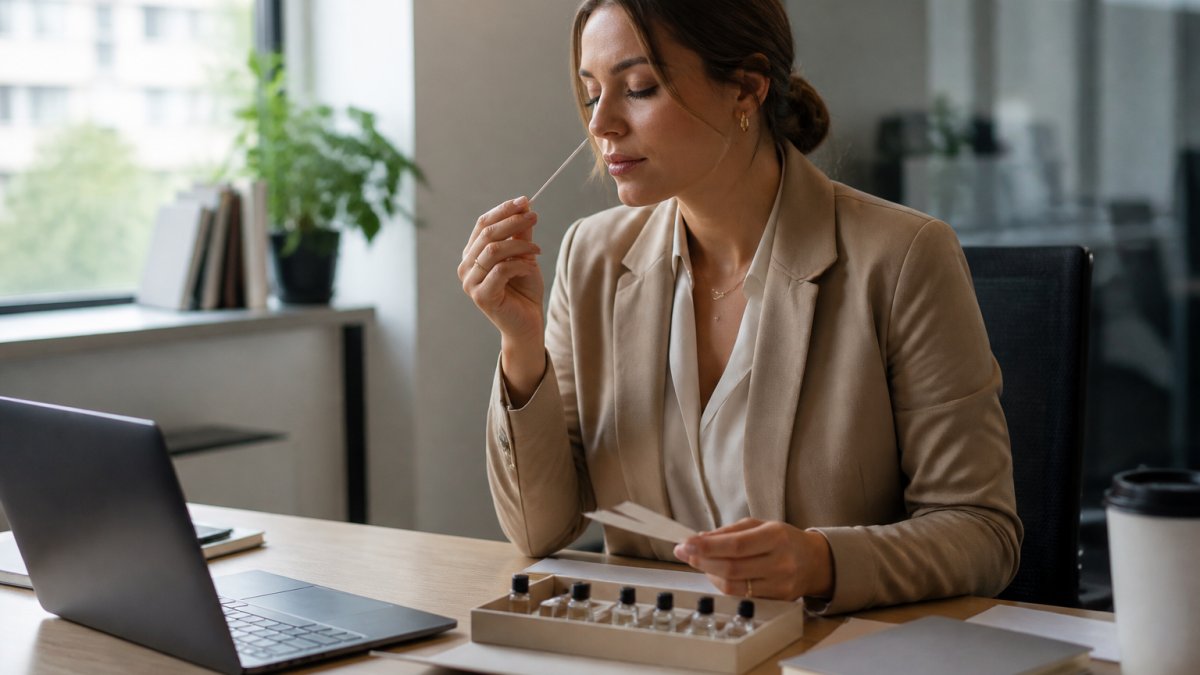
Fragrance smells different on paper, fabric, and skin. Paper strips sort scents fast, but your skin chemistry, body heat and oils, changes how a fragrance develops on you.
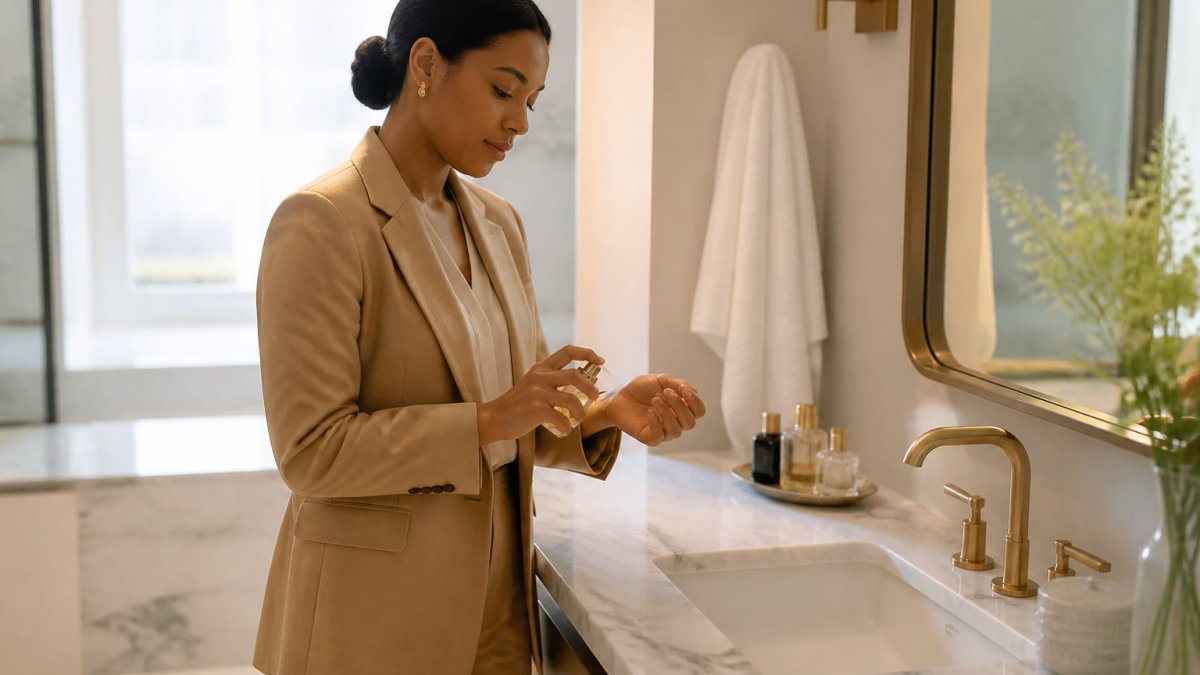
Test every serious candidate on your own skin: spray a small amount on your wrist or inner forearm, don't rub it in, and check back over the next few hours.
This is why discovery sets matter: sampling several scents on your own skin removes most of the guesswork.
The Best Scent for an Office Is the One Nobody Has to Notice
The best office scent is subtle, clean, and close to the skin, a private pleasure, not a public announcement.
Most guides treat office wear like evening wear, where bold is the goal. At work, the goal flips: you want low projection (how far the scent travels) and low sillage (the trail you leave behind).
Notes That Work in a Shared Space
Some notes are safer for close quarters:
- Fresh and citrus: clean, bright, and unlikely to bother anyone
- Light tea and green notes: calm and quiet
- Soft florals: peony or iris rather than heavy rose
Avoid, or save for evenings, the loud crowd: heavy oud, strong patchouli, and big spice blends. These project hard and linger in small rooms.
How Many Sprays of Perfume to Wear at Work
Spray count is the most controllable variable in office fragrance, and "two sprays" is a starting point, not a rule, the right count depends on concentration, projection, and the room.
Start With Concentration, Not Spray Count
Concentration tells you how much aromatic oil is in the bottle, which drives how loud each spray lands:
- Parfum / Extrait de Parfum: roughly 20-40% oil. One spray is often plenty for a full workday.
- Eau de Parfum (EDP): roughly 15-20% oil. One to two sprays is the usual office range.
- Eau de Toilette (EDT): roughly 5-15% oil. Two to three sprays, and it may fade by mid-afternoon.
These ranges are conventions, not rules, a dense oud EDP can project harder than a light extrait. Read concentration as a hint, then let your skin and the room confirm it.
A Practical Spray Guide by Setting
| Setting | Sprays | Where to Apply | Why |
|---|---|---|---|
| Open office, close desks | 1-2 | Wrists only | Keeps the scent within arm's reach |
| Cubicle or shared pod | 1 | One wrist, tapped to the other | Minimizes drift into neighboring space |
| Private office | 2-3 | Wrists and base of neck | Room absorbs the extra projection |
| Interview or first meeting | 1 | One wrist only | Removes any risk of a first-impression misfire |
| Client-facing role | 1-2 | Wrists, kept subtle | Close-range only; clients lean in, not across the table |
| Remote or hybrid day | 1-2 | Wrists | You set the ceiling; no shared air to manage |
Application Points and What They Change
Where you spray matters as much as how much:
- Wrists: the safest office choice. Body heat releases scent slowly, and you can smell it yourself without broadcasting it.
- Base of neck / throat: warmer and more diffusive. Use half your usual count here.
- Behind the ears: close to the nose of anyone you speak with. Skip in tight meeting rooms.
Don't rub your wrists together after spraying, friction crushes the top notes, shortens wear, and makes the scent read flatter.
Adjusting for Fragrance-Free Policies and Sensitive Coworkers
Many workplaces publish fragrance-free or fragrance-sensitive guidance tied to indoor air quality and accommodation practices. Treat yours as binding. Even without a formal policy:
- If a coworker has disclosed migraines, asthma, or chemical sensitivity, default to one spray or none.
- In shared meeting rooms, sit away from the air return and keep your count at the low end.
- If someone mentions your fragrance unprompted, that is a signal to cut back, not a compliment to lean into.
Reapplication: When and How
If your scent fades by early afternoon, resist re-spraying the same spots, layering over a fading application can double the intensity late in the day, when people are least tolerant of strong smells.
- Keep a travel atomizer and apply one spray to a single wrist, not both.
- Reapply after lunch, not before a meeting.
- If you are unsure, skip it. A faint scent at 4 p.m. is better than a loud one at 3 p.m.
Start lower than you think you need. You can always add a spray at lunch, but you cannot take one back.
How Long Does Perfume Last, and How to Keep It Discreet All Day
Most fragrances last four to eight hours on skin. Base-heavy scents with woods, musk, or amber last longer; light citrus fades fastest.
To keep a scent discreet through a full workday:
- Apply to moisturized skin, since dry skin lets scent fade faster
- Spray pulse points rather than clothing, which can hold scent too strongly
- Keep a travel size in your bag for a light midday touch-up
If a scent fades by early afternoon, that is often a good sign for office wear. A fragrance that is still loud at 5 p.m. was probably too strong at 9 a.m.
Match the Scent to Your Office Environment
Most signature-scent guides treat "the office" as one place. It is not. An open floor plan, a private office, a client's conference room, and your kitchen table each set a different ceiling on how much fragrance the space can absorb.
Open Plan, Cubicles, and Hot-Desking
Open offices have the least air per person and the most noses within range. Aim for fresh, citrus, light tea, or clean musk at one to two sprays on the wrists only. Avoid heavy oud, strong patchouli, or dense spice blends, they project across desks and linger in partitions. If you hot-desk, the person at your seat inherits whatever your clothing left behind.
Private Offices and Small Teams
A closed door gives you more latitude: two to three sprays of a richer scent, soft woods, iris, amber, or a restrained floral, stay in your space rather than drifting into the hallway. But private offices host impromptu meetings, so the scent should read as a background note, not a headline.
Client-Facing, Interview, and Presentation Days
Under-spray deliberately: one spray on one wrist, applied at least thirty minutes before you arrive so the loud top notes burn off by the handshake. Clean, minimal profiles, bergamot, light neroli, soft musk, read as polished rather than perfumed. Save polarizing scents for days without external meetings.
Remote and Hybrid Work
Remote days are the only time you set the ceiling yourself, ideal for testing bolder scents, longer dry-downs, and heavier bases. On hybrid schedules, keep two fragrances: a light office pick for in-person days and a richer one for home.
Fragrance-Free Workplaces and Coworker Sensitivities
If your workplace publishes fragrance-free or fragrance-sensitive guidance, follow it. Even without a formal policy, treat shared air as a shared resource:
- If a coworker has disclosed migraines, asthma, or chemical sensitivity, default to no fragrance or a single wrist spray.
- In shared meeting rooms, sit away from air returns and vents, which circulate scent through the room.
- If someone mentions your fragrance without being asked, that is a signal to cut back.
Climate, Season, and Commute
Heat and humidity amplify fragrance; cold and dry air mute it. The same two sprays that feel right in a climate-controlled January office can bloom hard on a humid August commute. Adjust by season and commute:
- Warm, humid days: cut your usual count by one spray and apply before you leave home, not in the car or on the train.
- Cold, dry days: scent fades faster on dry skin. Moisturize first, then apply, and expect to re-up lightly by afternoon.
- Crowded commutes: apply at home, not in transit. A confined train car or elevator concentrates fragrance far more than an open office.
Fragrance-Free and Low-Sillage Alternatives
Sometimes the right answer is no perfume at all. If your workplace is fragrance-free, a coworker is sensitive, or you simply want a subtler presence, these options keep you fresh without broadcasting:
- Scented body wash or lotion in a light, clean profile, the scent stays close and fades within hours.
- Fragrance-free grooming with a good deodorant and clean laundry, which removes the need to mask anything.
- A single spray on a scarf or pocket square rather than skin, so the scent stays personal and can be removed.
None of these replace a signature scent, they give you a graceful fallback for the days when the room, not your taste, should decide.
A Two-Week Office Scent-Testing Protocol
Two weeks is enough time to find a scent you trust at work. Test one scent per day, on skin, in your real environment, and note how it holds up.
Follow this plan:
- Days 1-3: Wear one spray of three different scents. Note which one you forget about, in a good way.
- Days 4-6: Try your favorites at two sprays. Watch for any headache or sneeze from you or nearby coworkers.
- Days 7-10: Wear your top pick through a full workday. Check how it smells at noon and at 4 p.m.
Conclusion
Finding a signature scent for the office takes patience, but the payoff is a fragrance that feels like you without crowding the room. The path is simple: learn your fragrance family, read the notes, test on skin, and keep it light.
Our fragrances are story-driven and made for everyday wear, and our discovery sets let you sample several scents on your own skin before you commit.
Frequently Asked Questions
What is the best scent for an office?
Scents built on citrus, light florals, tea, or soft woods tend to work best in shared spaces because they sit close to the skin and fade quietly. Heavy orientals, strong gourmands, and anything with heavy projection can travel across a room and bother coworkers. The goal is a scent people notice only if they are standing near you, not one that announces itself from the hallway.
How many sprays of perfume should I wear to the office?
Two sprays is the practical ceiling for most offices, and one is often enough. Apply to pulse points like the wrists or the base of the throat, then let the fragrance dry without rubbing. If your workplace is small, poorly ventilated, or has fragrance-sensitive employees, one spray or a fragrance-free option is the safer choice. You can always add more later, but you cannot take it back.
How long does perfume last on skin during a workday?
Most fragrances last four to six hours on skin, though this varies with concentration, skin chemistry, and how dry your skin is. Eau de toilette tends to fade faster than eau de parfum. To make a scent last through an eight-hour day without overapplying, moisturize before spraying and apply to pulse points rather than clothing. A travel atomizer lets you refresh once at midday without re-spraying your whole outfit.
How can I tell if a fragrance is too strong for work?
Ask one trusted coworker directly, ideally someone who will give you an honest answer. A simpler test: if you can still smell your own fragrance clearly two hours after applying, it is likely projecting further than you think. You can also spray it on a day off and notice whether people comment on it from a distance. Fragrances that draw comments from across a room are too strong for a shared office.