
How to Identify High Quality Perfume Ingredients
Table of Contents
- How to Read Perfume Ingredient Labels
- Common Perfume Ingredients and Their Uses
- Natural vs Synthetic Perfume Ingredients: What Actually Matters
- Perfume Ingredients for Longevity and Sillage
- How to Judge Ingredient Quality and Sourcing
- Safety, Allergens, and Regulatory Documentation
- Conclusion
- Frequently Asked Questions
Last Updated: October 8, 2026
How to Read Perfume Ingredient Labels
Identifying high quality perfume ingredients starts with reading the label.
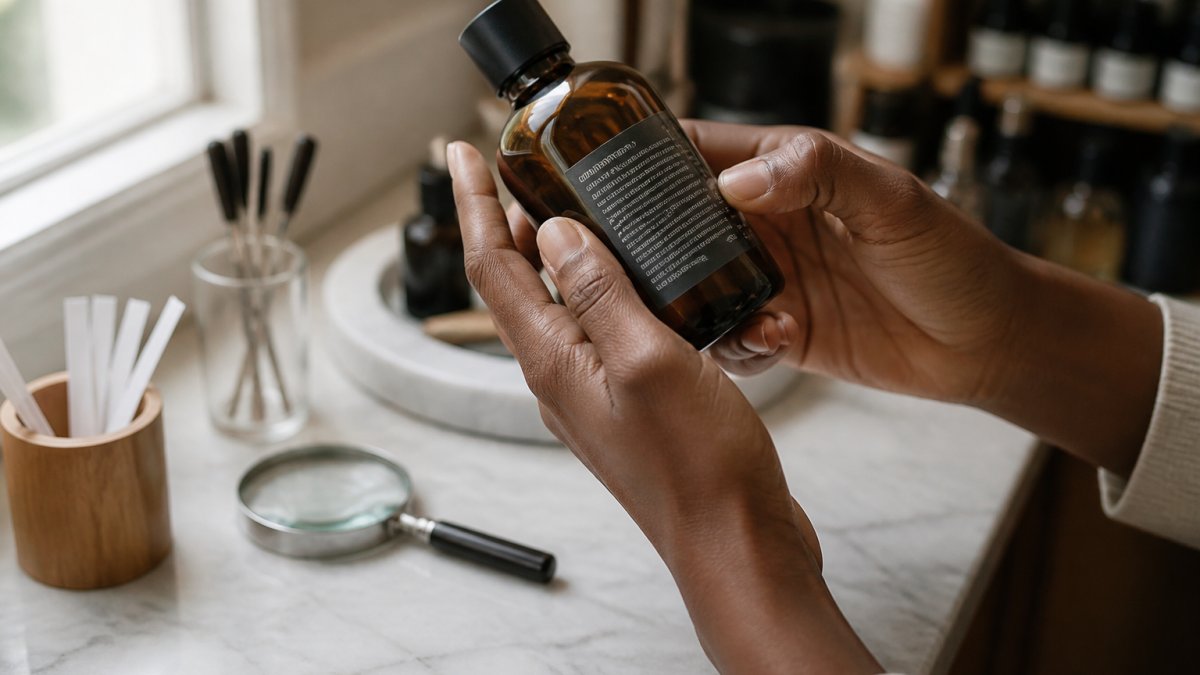
First thing to know: Parfum and fragrance are catch-all terms. A brand can list either and legally hide a blend of dozens of materials behind it.
- Alcohol denat (or ethanol): the carrier that makes the spray light and fast-drying
- Water (or aqua): a filler that softens the alcohol
- Parfum or fragrance: the scent concentrate itself
A short list is not automatically good, and a long list is not automatically bad. What matters is the order and what sits around those core items.
Decoding Parfum, Fragrance, and Aroma Chemicals
Parfum is the umbrella term for the entire scent blend, whether from a flower or a lab. Aroma chemicals are single, isolated scent molecules like vanillin or iso E super.
- Allergen declarations (required in many markets) hint at how complex the formula is
- Concentration terms tell you how much scent oil is present: eau de toilette is lighter, eau de parfum is richer
- A named hero ingredient, like rose or oud, often signals the brand is proud of its sourcing
Here is what most guides miss: the label is a legal document, not a marketing one. It tells you what must be disclosed, not what the perfumer is proud of.
Common Perfume Ingredients and Their Uses
Every fragrance is built from three layers: top, heart, and base notes. Knowing the materials in each helps you guess how a scent will behave before you spray it.
Natural Ingredients and Botanical Sources
Natural ingredients come from plants, flowers, resins, and animal sources. Common ones:
- Rose and jasmine: classic floral heart notes, often the most expensive materials in a formula
- Oud: a dark, resinous wood note from agarwood, prized in the Middle East
- Patchouli: an earthy base note that deepens over time
- Labdanum and styrax: sticky resins that add warmth and staying power
- Birch tar, juniper, and cade: smoky, leathery notes used in rugged scents
Natural materials vary from harvest to harvest, part of their charm, and a challenge for consistency.
Synthetic Ingredients and Aroma Chemicals
Synthetic ingredients are built in a lab. They include aroma chemicals like vanillin, ambroxan, and iso E super. They are not "fake" versions of naturals. Many have no natural equivalent at all.
Why use them?
- They are stable, so a scent smells the same every batch
- They are consistent, which keeps quality steady
- Some, like certain musk molecules, are safer and more sustainable than the animal sources they replaced
A well-made fragrance usually blends both. Naturals bring depth and surprise. Synthetics bring structure and staying power.
Natural vs Synthetic Perfume Ingredients: What Actually Matters
The honest answer: neither is better by default. A cheap natural oil can smell thin; a well-made synthetic can smell richer than the real thing. What matters is how the perfumer uses them together.
- Natural materials can be inconsistent and, in rare cases, more irritating than their synthetic twins
- Synthetic materials can be purer and more predictable
- The best formulas use each where it performs best
So judge the composition, not the category. A scent that opens cleanly, evolves smoothly, and lasts is well made, regardless of its source list.
Perfume Ingredients for Longevity and Sillage
Longevity is how long a scent lasts on skin; sillage is the trail it leaves. Both depend on the base materials, the heavy, slow-evaporating notes that keep a fragrance going after the top notes fade. For a scent that lasts, look for:
- Resins: labdanum, styrax, benzoin
- Woods: oud, sandalwood, cedar
- Musk molecules: ambroxan, galaxolide
Volatility is the science behind this: light molecules evaporate fast (top notes), heavy ones slowly (base notes). A fragrance with a rich base outlasts one built on citrus and light florals. One practical check: spray on skin, not paper, paper hides how a scent reacts to your body chemistry.
How to Judge Ingredient Quality and Sourcing
Most guides list ingredients and stop, never handing you a repeatable method. Here is one you can run in a store aisle, on a product page, or by email, plus an honest note on what you cannot verify as a shopper.
The four things quality actually shows up in
Ingredient quality is not a vibe. It shows up in four measurable places:
- Purity, how free a material is from unwanted byproducts, residual solvents, or adulterants.
- Consistency, whether batch 12 smells and performs like batch 1.
- Sourcing, where the raw material came from and how it was handled.
- Documentation, the paperwork that lets a buyer confirm the first three.
A brand can be strong on one and weak on another. Your job is to see which ones they can actually speak to.
What each document actually tells you
When you ask a brand about a material, here is what the common documents mean, and what they do not prove.
| Document | What it shows | What it does NOT prove |
|---|---|---|
| Certificate of Analysis (CoA) | Batch-specific test results: identity, purity, and often specific gravity or refractive index | That the material was ethically sourced or that the finished perfume performs well |
| Safety Data Sheet (SDS) | Hazards, handling, and first-aid info for a raw material | Anything about scent quality or concentration in the finished product |
| IFRA Certificate / Conformity Statement | The material's safe-use limit under the current IFRA Standard for the product category | That the perfumer used it well, or that the formula is 'clean' |
| Allergen declaration | Which declarable allergens are present above the labeling threshold | The full formula, most of the blend stays behind 'fragrance' or 'parfum' |
| Supplier specification sheet | The grade, origin region, and typical composition the supplier guarantees | That the brand actually bought that grade rather than a cheaper substitute |
A CoA is the closest thing to a purity receipt you can ask for. If a brand cannot produce one for a named hero material, say, a specific rose absolute or oud oil, that is a real signal.
Traceability: what it is and where it stops
Traceability means a material can be followed from farm or factory to finished bottle. In practice:
- A named region or farm (e.g., a specific patchouli cooperative, a named jasmine growing area)
- A harvest year or lot number
- A chain of custody from supplier to compounder to brand
Here is the honest limit: consumers rarely get access to full traceability records. Those documents sit between suppliers and brands, not on a product page. What you can usually get is a summary, region, harvest window, sometimes a supplier name. Treat a detailed public sourcing story as a good sign, not proof of purity.
Authenticity testing: what it can and cannot catch
For high-value naturals, oud, rose, jasmine, sandalwood, adulteration is a known problem in the trade. Common tests:
- Gas chromatography-mass spectrometry (GC-MS), separates and identifies the molecules in a sample; the standard tool for spotting dilution or substitution
- Isotope ratio analysis, can flag synthetic molecules passed off as natural
- Refractive index and specific gravity, quick physical checks that catch some adulterants
These tests are run by suppliers and labs, not shoppers. What you can do is ask whether a brand tests its hero materials and will share a summary of results. A serious house usually will.
A repeatable consumer checklist
Run these in order. Stop when a brand fails two or more.
- Named materials. Does the product page name specific materials, or only 'fragrance'?
- Concentration. Is the strength stated (eau de toilette, eau de parfum, extrait)?
- Sourcing story. Is there any region, farm, or supplier detail, even one sentence?
- Documentation on request. If you email and ask for a CoA or IFRA conformity statement, do you get a real answer?
- Batch consistency. If you buy twice, does the second bottle smell and last like the first?
- Performance. Does the base hold up on skin for the time the concentration implies?
What you cannot verify as a shopper
Be clear-eyed about the ceiling here:
- Smell alone cannot prove quality. A well-blended cheap formula can smell better than a poorly blended expensive one.
- Price alone cannot prove quality. Markup reflects brand, packaging, and marketing as much as materials.
- The label cannot prove purity. It tells you what must be disclosed, not what was tested.
Safety, Allergens, and Regulatory Documentation
Safety in fragrance is not a marketing word. It is a paper trail, and in the United States that trail runs through a few specific bodies and rules. Knowing who does what tells you which claims are checkable and which are just copy.
Who regulates fragrance in the United States
- FDA (Food and Drug Administration), oversees cosmetics, including fragrance, under the Federal Food, Drug, and Cosmetic Act (the FDA). Perfume is regulated as a cosmetic, not a drug, unless it makes drug claims.
- FPLA (Fair Packaging and Labeling Act), sets the labeling rules: net quantity, ingredient declaration, and the name and place of business of the manufacturer or distributor (the FTC).
- FTC (Federal Trade Commission), polices advertising claims (the FTC). If a brand says 'clean' or 'non-toxic,' that claim falls under FTC truth-in-advertising standards.
That distinction matters: RIFM assesses, IFRA sets limits, and the FDA enforces cosmetics law. A brand saying 'RIFM-reviewed' is not saying 'FDA-approved', no fragrance is FDA-approved, because the FDA does not pre-approve cosmetics.
What the label is required to disclose
Under U.S. labeling rules, a fragrance ingredient list typically shows:
- The word 'fragrance' or 'parfum' as a catch-all for the scent blend
- Declarable allergens when they exceed the labeling threshold, commonly the list of 26 fragrance allergens used as a benchmark in many markets
- Alcohol denat, water, and other carriers
Common declarable allergens include limonene, linalool, citronellol, geraniol, eugenol, coumarin, and hexyl cinnamal. Their presence is not a defect, it is disclosure working as intended.
What the label cannot establish
This is the part most guides skip:
- The label cannot prove purity. It lists what must be declared, not what was tested.
- The label cannot prove safety. A short list is not automatically safer than a long one.
- The label cannot prove sourcing. 'Contains rose' does not tell you which rose, from where, or at what grade.
How to read a safety claim without being misled
When a brand makes a safety or 'clean' claim, run it through these filters:
- Is it specific? 'IFRA-compliant per the current Standard' is checkable. 'Clean ingredients' is not.
- Is it documented? Ask for the IFRA conformity statement or the safety assessment summary.
- Is it consistent with the label? A 'clean' claim alongside a long undeclared allergen list is a contradiction.
- Does it overreach? 'Non-toxic' is an absolute claim. No responsible formulator makes absolutes about skin reactions.
Allergens: what to actually watch for
If you have known sensitivities, the practical moves are:
- Patch-test on a small area of skin before full wear
- Keep a personal list of the declarable allergens that have bothered you
- Prefer brands that publish full allergen declarations rather than hiding behind 'fragrance'
Conclusion
Judging perfume ingredients comes down to a few habits: read the full label, look past "parfum," and check for named materials, clear concentration, and verifiable sourcing.
That is the standard we hold ourselves to at Ruth+Bo. Our discovery sets let you sample scents before committing, and our thematic gift sets pair fragrances for couples and milestones.
Frequently Asked Questions
What makes a perfume ingredient high quality?
High quality perfume ingredients come from reputable sources, are processed to preserve their scent profile, and are used in effective concentrations. Look for transparent sourcing, consistent quality control, and a fragrance that evolves well on your skin. Natural materials should be pure and properly extracted; synthetics should be stable and well-blended. The overall composition matters more than any single ingredient.
How can you tell if a perfume has quality ingredients?
You can assess quality by reading the ingredient list for specific natural materials like rose, jasmine, or oud, and checking for allergens like limonene or linalool. A well-structured fragrance will have clear top, heart, and base notes that unfold over time. Longevity and sillage also indicate quality: a good perfume lasts several hours and leaves a subtle trail. Avoid vague terms like 'fragrance' without further detail.
Are natural perfume ingredients better than synthetic ones?
Not necessarily. Natural ingredients like essential oils can be beautiful but vary in quality and may cause allergies. Synthetic aroma chemicals offer consistency, safety, and creative flexibility. Many high-quality perfumes blend both to achieve complexity and performance. The key is the skill of the perfumer and the quality of raw materials, not whether they are natural or synthetic.
What ingredients make a perfume last longer?
Base notes such as patchouli, oud, labdanum, and synthetic musks or amber materials are known for longevity. They have low volatility and evaporate slowly, anchoring the scent. Concentration also matters: eau de parfum and parfum contain higher percentages of fragrance oils than eau de toilette. Proper application on moisturized skin can further extend wear.