
How to Find Your Signature Scent: A Step-by-Step Guide
Table of Contents
- What You'll Need Before You Start Finding Your Signature Scent
- Fragrance Families Explained: Your First Step to Narrowing It Down
- Understanding the Olfactory Pyramid: Top, Heart, and Base Notes
- How Does Skin Chemistry Affect Perfume? What You Need to Know
- How to Choose a Perfume That Lasts: Concentration, Application, and Longevity
- Take a Scent Personality Quiz to Identify Your Signature Scent
- Two Things Most Guides Skip: Scent Layering and Fragrance Etiquette
- Budget-Conscious Fragrance Discovery: Samples, Discovery Sets, and Scent Fatigue
Last Updated: July 30, 2026
Knowing how to find a signature scent is one of the most personal decisions you'll make about self-presentation, yet most people approach it by wandering through a department store, spraying paper strips, and leaving overwhelmed. This guide from Ruth+Bo breaks that cycle with a structured framework that accounts for everything from your skin chemistry to your professional environment.
A signature scent is not simply the perfume you wear most often. It is a consistent olfactory expression of who you are, one that becomes recognizable to others before you enter a room. That distinction changes how you shop for it.
What You'll Need Before You Start Finding Your Signature Scent
Start here before you spend a dollar. Rushing into fragrance shopping without preparation wastes money and leaves you with bottles you'll never finish.
What to gather before you begin:
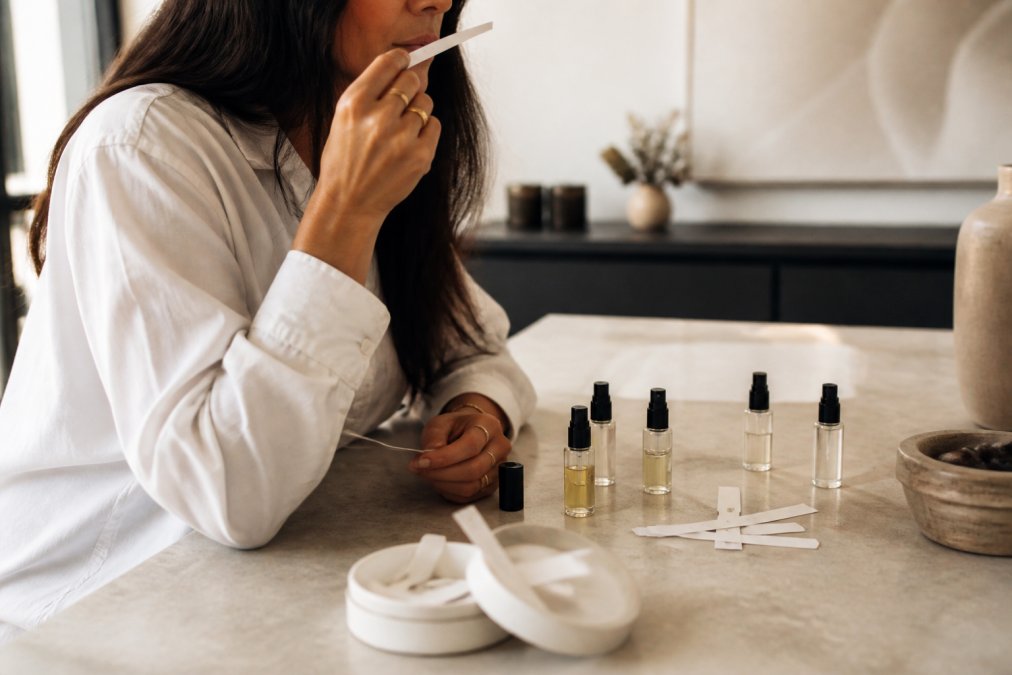
- A clear, unscented day (avoid heavy food, coffee, or other fragrances beforehand)
- Access to sample vials or a discovery set rather than full bottles
- A notepad or notes app to record your reactions
- At least two separate testing sessions, ideally on different days
Your nose can only reliably evaluate three to four fragrances in a single session before olfactory fatigue sets in. After that point, everything smells similar and your judgment becomes unreliable. Plan your exploration accordingly.
Discovery sets are the most practical starting point. They let you test multiple scents on your own skin, in your own environment, over several days, the only accurate way to evaluate how a fragrance will perform in your actual life.
Fragrance Families Explained: Your First Step to Narrowing It Down
Fragrance families are the broadest organizational framework in perfumery, and understanding them cuts your search time in half. Rather than evaluating every perfume on the market, you identify which family resonates with your instincts and narrow from there.
Floral, Woody, Oriental, and Citrus: The Core Families
The four classical fragrance families cover the majority of what you'll find on any shelf:
- Floral: Built around flower extracts like rose, jasmine, and peony. Ranges from light and airy to rich and heady. The most commercially prevalent family, especially in feminine-leaning collections.
- Woody: Grounded in materials like sandalwood, cedarwood, vetiver, and oud. Projects warmth and depth. Common in masculine collections but increasingly gender-neutral.
- Oriental: Characterized by amber, resin, vanilla, and spice. Rich, warm, and long-lasting. Often described as sensual or mysterious.
- Citrus: Built on bergamot, lemon, grapefruit, and neroli. Fresh, clean, and immediate. Tends to have shorter longevity than heavier families.
A common mistake is dismissing an entire family based on one bad experience. Florals are not all powdery. Orientals are not all heavy.
Gourmand, Musk, and Amber: The Modern Additions
Perfumery has expanded well beyond the classical four:
- Gourmand: Edible-inspired notes like vanilla, caramel, chocolate, and praline. Often layered over a woody or oriental base.
- Musk: Soft, skin-like, and intimate. Synthetic musk accords provide that "second skin" quality that makes a scent feel like it belongs to you.
- Amber: Warm, resinous, and slightly sweet. Functions as its own family in contemporary fragrance classification.
According to The Fragrance Foundation's industry resources, the gourmand and amber categories have seen consistent growth in consumer preference over the past decade, reflecting a shift toward warm, cocooning scents.
Understanding the Olfactory Pyramid: Top, Heart, and Base Notes
The olfactory pyramid is the structural architecture of every modern perfume. Understanding it is essential if you want to evaluate a fragrance accurately rather than reacting to its first impression.
Top notes are what you smell immediately after application. They are the lightest, most volatile molecules, typically citrus, herbs, or light florals. They last 15 to 30 minutes.
Heart notes (also called middle notes) emerge as the top notes fade. These form the true character of the fragrance: rose, jasmine, spice, or woody elements. Heart notes last two to four hours.
Base notes are the foundation. They are the heaviest, longest-lasting molecules: musk, amber, sandalwood, vetiver, vanilla. Base notes determine longevity and are what you smell six to eight hours after application.
Never buy a fragrance based on how it smells in the first five minutes. The dry down, when the base notes fully emerge and the fragrance settles into your skin chemistry, is what you will actually live with all day.
| Phase | Notes | Duration | Examples |
|---|---|---|---|
| Top | Citrus, herbs, light florals | 15-30 minutes | Bergamot, lemon, mint |
| Heart | Florals, spice, soft woods | 2-4 hours | Rose, jasmine, cardamom |
| Base | Resin, musk, deep woods | 6-8+ hours | Amber, sandalwood, musk, oud |
How Does Skin Chemistry Affect Perfume? What You Need to Know
Skin chemistry is the most underestimated variable in fragrance selection. The same perfume can smell dramatically different on two people due to biochemistry.
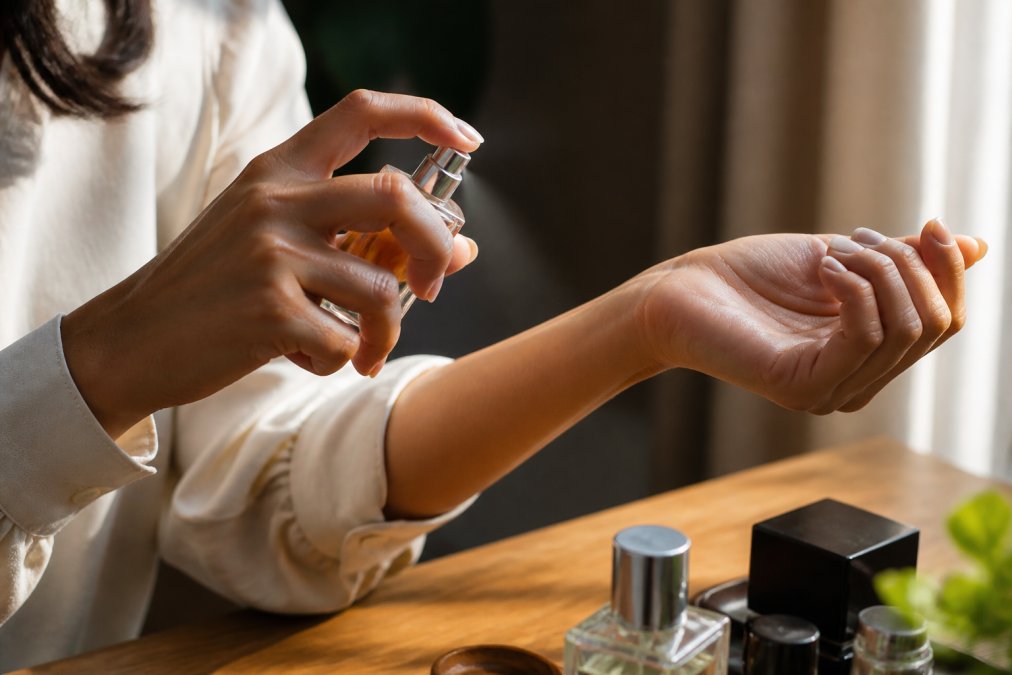
Several factors influence how a fragrance performs on your skin:
- pH level: Acidic skin tends to amplify musks and spices, while muting others.
- Hydration: Well-moisturized skin holds fragrance longer. Dry skin shortens longevity and reduces projection.
- Body temperature: Warmer skin amplifies sillage and projection.
- Diet and hormones: These affect skin's natural scent profile, which interacts with fragrance chemistry.
Always test a fragrance on your skin, not on a paper tester strip. A strip tells you what the perfumer intended. Your skin tells you what you will actually wear.
This is why online fragrance purchases carry risk. A discovery set solves this problem by letting you test samples at home, on your actual skin, before committing to a full bottle.
How to Choose a Perfume That Lasts: Concentration, Application, and Longevity
Longevity is one of the most common fragrance frustrations. A scent that fades within two hours may simply be the wrong concentration for your needs.
Eau de Toilette vs. Eau de Parfum vs. Parfum: Which Concentration Is Right for You
Fragrance concentration determines how much aromatic compound is present in the formula, which directly affects longevity and projection:
- Eau de Cologne: Typically 2-4% concentration. Light, fresh, short-lasting. Best for casual, daytime use.
- Eau de Toilette: Typically 5-15% concentration. The most common category. Moderate longevity, three to five hours.
- Eau de Parfum: Typically 15-20% concentration. Richer, longer-lasting, five to eight hours. Better suited to evening wear or all-day presence.
- Parfum: Typically 20-30% concentration. The most intense and longest-lasting. A small amount goes a long way.
The right concentration depends on your lifestyle. A light eau de toilette is appropriate for office environments where fragrance etiquette matters. An eau de parfum is better suited for evenings or occasions where you want the scent to carry.
Where to Apply Perfume for Maximum Sillage and Projection
Application technique affects both longevity and sillage, the trail a fragrance leaves as you move.
Apply to pulse points where body heat amplifies the scent:
- Inner wrists
- Base of the throat
- Behind the ears
- Inner elbows
- Behind the knees (for all-day wear)
Do not rub your wrists together after applying. Rubbing breaks down the top notes prematurely and disrupts the fragrance's intended dry down. Press, do not rub.
Applying fragrance to moisturized skin significantly extends longevity. Fragrance adheres to oils, not dry skin.
Take a Scent Personality Quiz to Identify Your Signature Scent
A scent personality quiz is a structured diagnostic tool that maps your aesthetic preferences, lifestyle habits, and emotional associations to fragrance families and specific accords. It is the fastest way to generate a shortlist of candidates without testing dozens of options blind.
Well-designed quizzes ask about the environments you prefer, the emotions you want a fragrance to evoke, your existing wardrobe aesthetic, and the occasions you dress for most often. The output is a scent profile, a set of fragrance families and notes most likely to align with your personality.
According to research on olfactory and emotional memory from the Smell and Taste Treatment and Research Foundation, scent is more directly connected to emotional memory than any other sense, which is why fragrance preferences are deeply personal and often tied to specific life experiences.
Use quiz results as a starting point for your discovery set selection, not as a final answer. A quiz narrows the field, but it does not replace skin testing.
Two Things Most Guides Skip: Scent Layering and Fragrance Etiquette
This is the part that separates a fragrance enthusiast from someone who simply wears perfume. Both scent layering and professional fragrance etiquette are largely absent from mainstream guides, and both matter enormously in practice.
Scent Layering Techniques to Build Depth and Uniqueness
Scent layering is the practice of combining two or more fragrances to create a personal accord that does not exist in any single bottle. It is how experienced fragrance wearers build a signature scent that is genuinely their own.
How to layer effectively:
- Start with the heavier fragrance first. Apply the woodier or more oriental scent as your base layer.
- Add the lighter fragrance on top. Citrus or floral notes applied second will lift and brighten the base.
- Apply to different zones if needed. Some combinations work better when kept spatially separate on the body.
- Test the combination over a full dry down before committing.
A common layering approach: pair an unscented or lightly scented body lotion from the same fragrance line with the eau de parfum. This extends longevity while adding dimensional depth.
Restraint is everything. Two fragrances that are individually beautiful can become cloying when combined in full application quantities. Start with half the normal amount of each.
Fragrance Etiquette in Professional Settings
Fragrance etiquette in professional settings is a topic most perfume guides ignore entirely. Many workplaces, medical facilities, and client-facing environments have explicit or implicit expectations around scent intensity.
Your fragrance should be perceptible to someone within arm's reach, not across the room. In professional environments, opt for:
- Lower concentrations: eau de toilette rather than eau de parfum
- Fresher, cleaner fragrance families: citrus, light woods, soft musks
- Single application to one or two pulse points rather than full coverage
Budget-Conscious Fragrance Discovery: Samples, Discovery Sets, and Scent Fatigue
The most expensive mistake in fragrance is buying full bottles before you know what you love. A 100ml bottle of a fragrance that does not suit your skin chemistry is not a bargain at any price.
The smarter approach is structured sampling. Most quality fragrance brands, including Ruth+Bo, offer discovery sets that let you explore multiple scents at a fraction of the cost of full bottles.
A practical discovery framework:
| Stage | Action | Goal |
|---|---|---|
| 1. Research | Take a scent personality quiz, identify 2-3 fragrance families | Narrow the field |
| 2. Sample | Order a discovery set covering your target families | Test on skin over multiple days |
| 3. Evaluate | Wear each sample for a full day, note longevity and dry down | Identify top candidates |
| 4. Commit | Purchase full bottle of your top one or two selections | Build your fragrance wardrobe |
| 5. Expand | Add seasonal or occasion-specific scents over time | Develop a complete scent profile |
Scent fatigue occurs when your nose becomes temporarily desensitized to a fragrance after prolonged exposure. You stop smelling what others can still clearly detect. Take breaks of at least 30 minutes between evaluations, and do not test more than four fragrances in a single session.
According to olfactory science resources from the National Institutes of Health, the olfactory system's ability to reset is well-documented, but repeated exposure to the same molecule over a short period significantly reduces detection sensitivity.
Most people find that three to five fragrances cover their needs: a daytime or office scent, an evening or occasion scent, a warm-weather option, and a cold-weather option. Start with one you love completely, then build deliberately from there.
Finding your signature scent takes patience, but the process does not have to be expensive or overwhelming. Ruth+Bo's discovery sets are designed specifically for this kind of deliberate exploration, offering curated, story-driven fragrances across both feminine and masculine collections so you can test multiple scents on your own skin before committing. Each refined fragrance is designed to evoke meaning and elegance, making Ruth+Bo stand out as a brand that delivers more than just a scent, but a personal journey. Add a Ruth+Bo discovery set to your cart and begin building a scent identity that is entirely your own.
Frequently Asked Questions
What is a signature scent and why does it matter?
A signature scent is a fragrance you wear consistently enough that others associate it with you, it becomes part of your personal identity. Finding your signature scent matters because scent is one of the most powerful memory triggers we have. A well-chosen fragrance can shape how others perceive you, reinforce your confidence, and serve as a meaningful form of self-expression. It does not have to be a single perfume; some people build a small fragrance wardrobe of two or three complementary scents.
How does skin chemistry affect perfume, and why does the same fragrance smell different on different people?
Skin chemistry affects perfume because your skin's pH level, moisture content, and natural oils all interact with a fragrance's ingredients during the dry down process. A scent that smells warm and spicy on one person may read as sharp or flat on another. This is why testing a sample directly on your skin, not just on a paper tester, is essential before committing to a full bottle. Factors like diet, medications, and even stress levels can subtly shift how a fragrance accord develops on your skin over time.
How long does it take to find a signature scent?
Finding your signature scent can take anywhere from a few weeks to several months, depending on how methodically you approach it. Rushing the process is one of the most common mistakes people make. A practical approach is to start with a discovery kit that lets you sample multiple scents across different fragrance families. Wear each sample for a full day before judging it, since top notes fade quickly and the heart and base notes tell the real story of whether a fragrance suits your scent profile and lifestyle.
Can you have more than one signature scent?
Yes, many fragrance enthusiasts build what is called a fragrance wardrobe, selecting different scents for different seasons, occasions, or moods. For example, a light citrus or floral eau de toilette might serve as your warm-weather daytime scent, while a deeper woody or oriental eau de parfum becomes your evening or cold-weather choice. Having two or three go-to fragrances is not indecisive; it reflects a mature understanding of how scent interacts with context, environment, and personal style.
What are fragrance families, and which one should I start with?
Fragrance families are broad categories that group perfumes by their dominant olfactory character. The main families include floral, woody, oriental, citrus, gourmand, musk, and amber. To find your signature scent efficiently, start by identifying which family aligns with your natural preferences, do you gravitate toward fresh and clean, warm and spicy, or soft and powdery? A discovery set that spans multiple fragrance families is the most budget-conscious and practical way to explore your scent personality without overspending on full bottles.
Should I test perfume on paper or directly on my skin?
Always test on skin before buying. Paper testers are useful for getting a quick first impression of a fragrance's top notes, but they cannot replicate how your unique skin chemistry will interact with the heart and base notes as the scent dries down. Apply a small amount to your inner wrist or the inside of your elbow, then wait at least 20 to 30 minutes before evaluating. If you are testing multiple fragrances at once, sniffing coffee beans between each one can help reset your olfactory senses and reduce scent fatigue.
This article was written using GrandRanker