
How Skin Chemistry Affects Perfume
Table of Contents
- How Skin Chemistry Affects Perfume
- The Role of Skin pH and Acid Mantle
- Sebum Production and Fragrance Molecules
- Best Perfume for Dry Skin
- How to Test Perfume on Your Skin
- How to Make Perfume Last Longer on Your Skin
- Environmental and Seasonal Factors That Shape Your Scent
- Conclusion
Last Updated: August 19, 2026
How Skin Chemistry Affects Perfume
Your skin isn't a neutral canvas for fragrance. It's an active chemical environment that transforms how a perfume smells from the moment you apply it. Fragrance molecules interact with your skin's pH, sebum production, temperature, and microbiome, fundamentally changing the scent profile you experience. A fragrance that blooms beautifully on one person might smell flat on another, not because one of you chose poorly, but because your skin chemistry is literally rewriting the composition.
At Ruth+Bo, we understand that selecting a fragrance means considering your unique skin chemistry. Our story-driven fragrances are designed to evolve on the skin, which means they interact with your individual chemistry in meaningful ways. Knowing how skin chemistry affects perfume helps you find fragrances that genuinely resonate with your chemistry rather than fighting against it.
Below, we'll walk you through the biological factors that shape your scent experience, practical testing methods, and proven strategies to maximize fragrance longevity on your specific skin type.
The Role of Skin pH and Acid Mantle
Your skin maintains an acidic pH between 4.5 and 5.5, a protective layer called the acid mantle. This pH level directly influences how fragrance molecules behave on your skin surface. When fragrance molecules meet your skin's acidic environment, a chemical interaction occurs that can either enhance or diminish the scent.
If your skin runs more acidic (closer to 4.5), fragrance molecules break down faster, making top notes more prominent but shortening overall longevity. Slightly less acidic skin may preserve fragrance molecules longer, allowing base notes to develop more fully. This is why the same perfume might last three hours on one person and six hours on another.
Skincare products significantly impact your acid mantle. Harsh cleansers strip away protective oils and elevate pH, disrupting how your skin holds fragrance. Using a gentle, pH-balanced cleanser helps preserve the conditions that allow perfume to develop properly.
Sebum Production and Fragrance Molecules
Sebum, the natural oil your skin produces, is the primary vehicle that carries fragrance molecules across your skin surface. Without adequate sebum, fragrance molecules evaporate quickly rather than developing over time. This is why people with very dry skin often complain that perfume doesn't last.
Sebum production varies significantly based on genetics, hormones, age, and skin type. Someone with naturally oily skin has more sebum to distribute fragrance molecules, resulting in stronger sillage and longer wear time. Dry skin produces less sebum, meaning fragrance molecules evaporate more rapidly.
The relationship between sebum and fragrance molecules also explains why fragrances smell different at different times of day. Morning skin often has lower sebum levels after a night of minimal oil production, while evening skin has accumulated sebum throughout the day.
Best Perfume for Dry Skin
Finding the best perfume for dry skin requires understanding that your chemistry needs different support than oily or combination skin. Dry skin's lower sebum production means fragrance molecules have less carrier medium, so they evaporate faster unless you compensate through product choice and application strategy.
The best perfume for dry skin prioritizes fragrance concentration and longevity. Eau de parfum (15-20% fragrance concentration) outperforms eau de toilette (5-15%) on dry skin because the higher concentration means more fragrance molecules are present when evaporation begins. Heavier, more complex fragrances with rich base notes, amber, vanilla, sandalwood, or musk, tend to perform better on dry skin than light, citrus-forward scents.
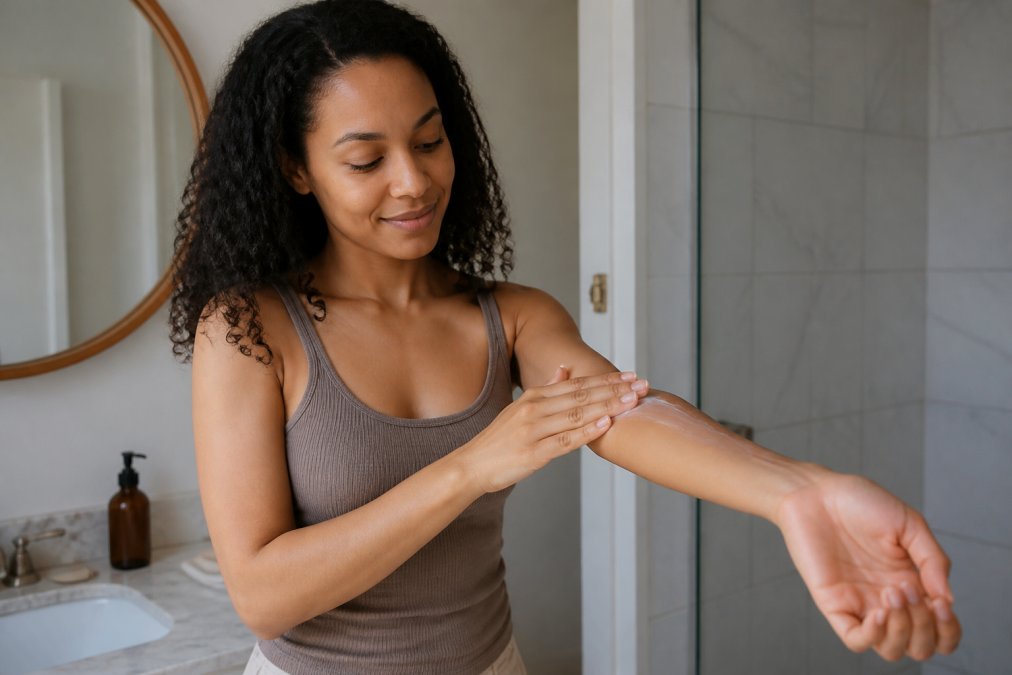
Layering is your most powerful tool. Apply an unscented or lightly scented moisturizer to damp skin immediately after showering, then apply your fragrance while the skin is still slightly damp. The moisture creates a temporary barrier that slows evaporation, and the moisturizer's oils provide additional carrier medium for fragrance molecules. This simple step can extend fragrance longevity by 50% or more on dry skin.
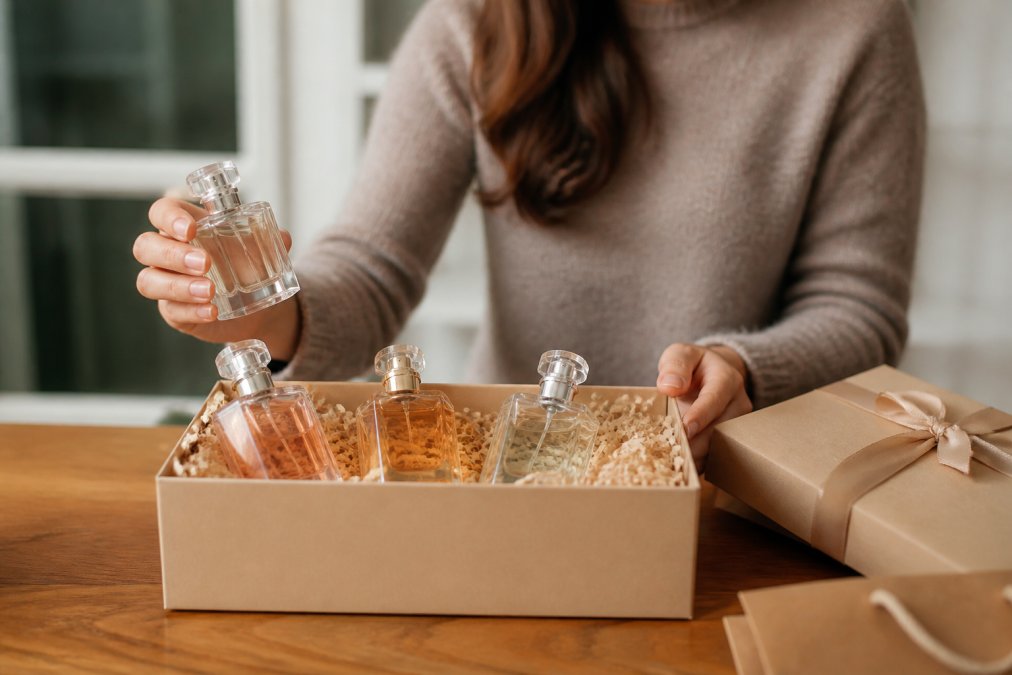
Ruth+Bo's discovery sets allow you to test how different fragrance profiles interact with your dry skin before committing to a full bottle. Our story-driven compositions often feature complex base notes that perform exceptionally well on dry skin because they're designed to evolve and deepen over time.
How to Test Perfume on Your Skin
Testing perfume on your skin is fundamentally different from testing on a paper strip. Your skin's chemistry, temperature, and sebum production create conditions that a blotter can never replicate.
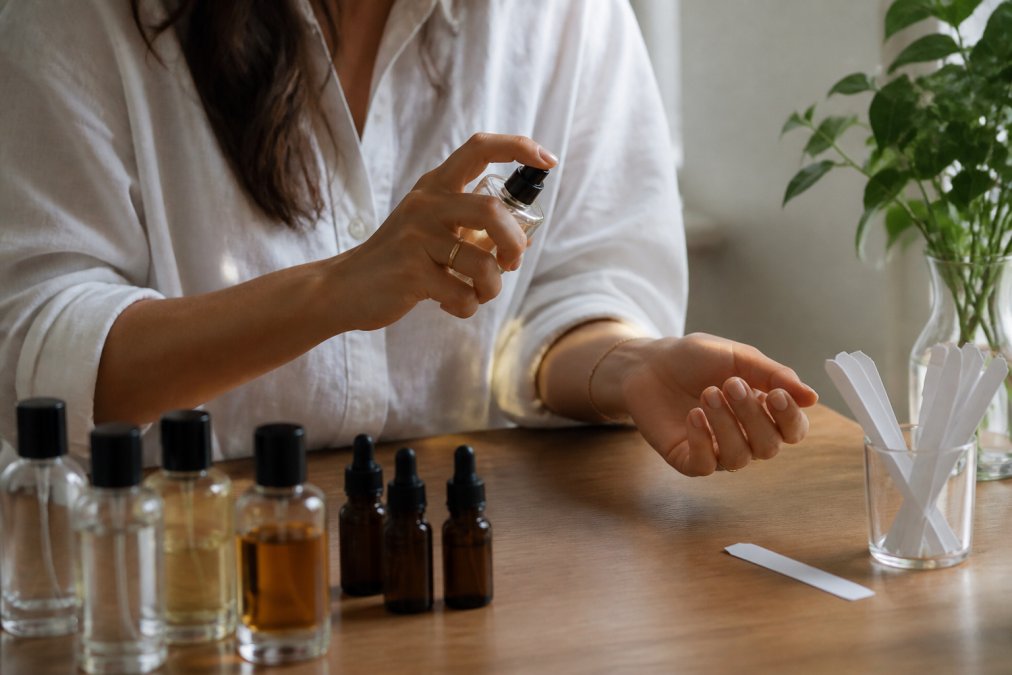
Cleanse your inner wrist or the inside of your elbow with a gentle, unscented soap and pat dry. These areas have thinner skin, higher blood flow, and greater sebum concentration, they're the most representative test sites for how a fragrance will perform on your body. Apply one spray of fragrance to each test site and wait. Don't rub your wrists together, as this breaks down fragrance molecules and doesn't represent how the scent will naturally develop.
Assess the fragrance at three intervals: immediately (top notes), after 15 minutes (heart notes emerging), and after one hour (dry-down phase). This timeline reveals how the fragrance evolves on your specific skin chemistry.
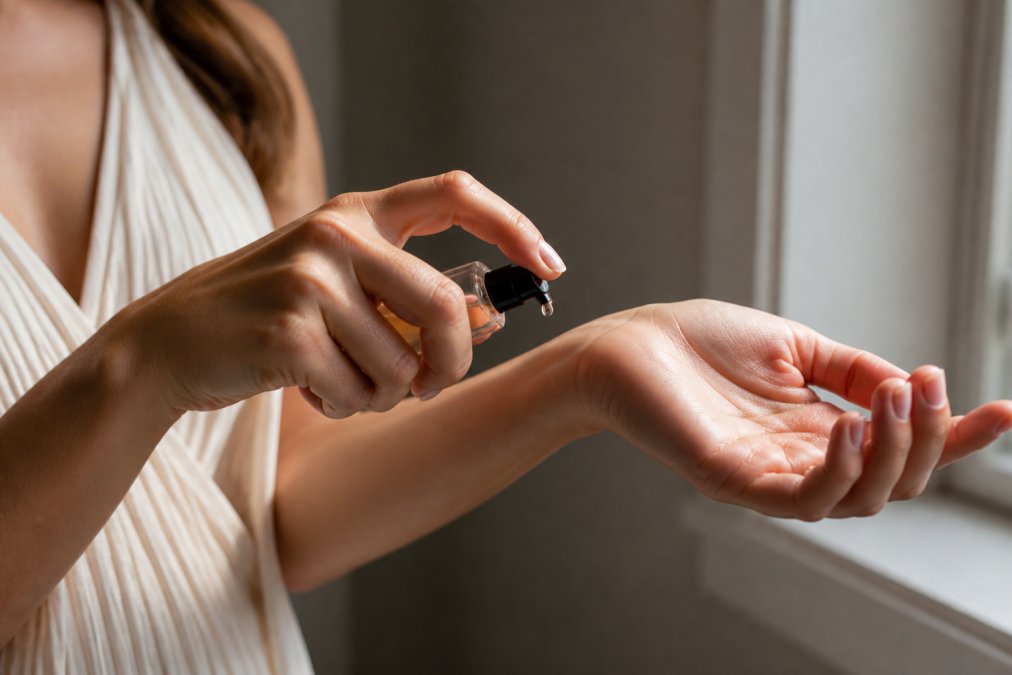
Temperature matters significantly during testing. Test fragrances when your skin is at a normal temperature, not immediately after a hot shower when evaporation accelerates. Test no more than three fragrances per session, with at least 15 minutes between applications, to avoid olfactory fatigue.
How to Make Perfume Last Longer on Your Skin
Making perfume last longer on your skin requires working with your skin chemistry, not against it. Hydrate your skin before applying fragrance by applying an unscented moisturizer or body lotion to damp skin immediately after showering, then wait 2-3 minutes for it to absorb slightly. Apply your fragrance to pulse points, inner wrists, inside elbows, behind ears, base of throat, where your skin's natural warmth accelerates the fragrance's development.
Fragrance concentration influences longevity more than application technique. Eau de parfum contains 15-20% fragrance concentration, while eau de toilette contains 5-15%. On the same skin, eau de parfum will outlast eau de toilette by several hours.
Strategic layering extends longevity significantly. Use a fragrance-free or matching-scent body lotion as a base layer, then apply your fragrance. Some people also lightly mist their hair with fragrance, as hair's texture traps fragrance molecules longer than skin does.
Avoid common longevity killers: don't apply fragrance to areas that will be washed frequently, don't apply immediately before or after vigorous exercise, and don't apply to areas where you'll perspire heavily.
Environmental and Seasonal Factors That Shape Your Scent
Your skin chemistry responds to environmental conditions that shift seasonally and daily. Temperature, humidity, and air quality all influence how your skin's pH, sebum production, and hydration levels fluctuate.
Cold weather typically reduces sebum production and skin hydration, creating conditions where fragrance evaporates faster. Humidity has the opposite effect: in warm, humid conditions, your skin retains more moisture, produces more sebum, and your skin's surface temperature is elevated. All three factors slow evaporation and extend fragrance longevity.
Seasonal changes also shift which fragrance families perform best. In winter, heavier fragrances with rich base notes perform beautifully because cold air concentrates the scent around your body. In summer, lighter fragrances with fresh top notes feel more appropriate and perform better because they won't feel overwhelming in heat.
Your own skin chemistry fluctuates seasonally too. Many people experience increased oil production in summer and drier skin in winter. If you love a fragrance in summer but find it fades too quickly in winter, the issue isn't the fragrance, it's that your skin chemistry has changed with the season.
Conclusion
How skin chemistry affects perfume is the difference between a fragrance that feels like an afterthought and one that becomes part of your personal identity. Your pH balance, sebum production, hydration level, and skin's surface temperature are constantly reshaping the fragrance you're wearing. The goal isn't to fight these biological realities, it's to understand them and choose fragrances and application strategies that work with your unique chemistry.
Testing on your actual skin, choosing fragrance concentrations that match your skin type, and preparing your skin with proper hydration are the practical steps that transform fragrance performance. At Ruth+Bo, our story-driven fragrances are formulated to evolve beautifully on skin, designed to interact meaningfully with your chemistry rather than sitting on top of it. Discover which Ruth+Bo fragrances align with your skin chemistry and experience how the right scent becomes part of your personal narrative.
| Factor | Impact on Fragrance | How to Optimize |
|---|---|---|
| Skin pH (4.5-5.5) | Affects fragrance molecule breakdown and longevity | Maintain acid mantle with gentle pH-balanced cleansers |
| Sebum production | Provides carrier medium for fragrance molecules | Hydrate before application; choose eau de parfum for dry skin |
| Skin hydration | Slows evaporation and extends wear time | Apply moisturizer before fragrance on damp skin |
| Skin temperature | Accelerates fragrance development and projection | Apply to pulse points where warmth is naturally higher |
| Environmental humidity | High humidity slows evaporation; dry air accelerates it | Choose heavier fragrances in winter, lighter ones in summer |
| Seasonal changes | Skin chemistry shifts with temperature and humidity | Rotate fragrance collection based on seasonal skin changes |
Frequently Asked Questions
How does skin pH level influence how long perfume lasts?
Your skin's pH balance directly affects how fragrance molecules interact with your skin. The acid mantle, your skin's naturally acidic layer, can either enhance or diminish scent longevity. Skin with a balanced pH (around 4.5 to 5.5) typically holds fragrance longer because the acidic environment stabilizes volatile compounds. If your skin is too alkaline, fragrance molecules evaporate faster, reducing longevity. Understanding your skin's pH helps you choose fragrances and application methods that work with your chemistry rather than against it.
Why does the same perfume smell different on two people with different skin chemistry?
Skin chemistry creates a unique canvas for fragrance. Factors like sebum production, hydration levels, skin pH, body temperature, and even diet influence how fragrance molecules interact with your skin. Someone with oily skin may experience stronger sillage and longer wear time because sebum holds fragrance molecules. A person with dry skin might notice the scent fades faster but smells softer and closer to the body. Hormonal fluctuations, microbiome differences, and perspiration rates also play roles. This is why testing fragrance on your own skin is essential before purchasing.
Can skincare products like lotions or oils change how my fragrance smells?
Yes. Hydrating products create a barrier that affects how fragrance molecules disperse and evaporate. Applying unscented lotion or body oil before fragrance creates a smoother surface, allowing fragrance to project more evenly and last longer. Scented skincare products can also interact with your fragrance, either complementing or clashing with the scent profile. If you use fragranced body products, choose ones with subtle or matching notes to avoid olfactory confusion. Unscented moisturizers are the safest choice if you want your fragrance to perform as intended.
How can I test if a fragrance will work with my skin chemistry before buying?
Apply fragrance to pulse points, wrists, inner elbows, behind ears, and the base of your throat, where skin temperature is highest and fragrance develops naturally. Wear it for at least 4-6 hours, noting how the scent evolves. Pay attention to the dry down (how it smells after initial application fades) and how long it lasts. If possible, test on clean, hydrated skin to see the true scent profile. Ruth+Bo's discovery sets allow you to sample multiple fragrances on your skin chemistry before committing to full-size bottles, reducing the risk of purchasing a scent that doesn't work for you.
This article was written using GrandRanker