
Best Way to Organize Fragrance Samples
Table of Contents
- Step 1: Sort and Categorize Your Fragrance Samples
- Step 2: Choose the Right Storage Containers for Small Vials
- Step 3: Label Every Vial for Easy Identification
- Perfume Storage Best Practices: Light, Temperature, and Upright Placement
- How to Make Perfume Last Longer With Proper Sample Care
- Build a Fragrance Inventory Tracker for Your Collection
- Organizing Samples for Travel and Display
- Frequently Asked Questions
Last Updated: September 11, 2026
Step 1: Sort and Categorize Your Fragrance Samples
The best way to organize fragrance samples starts with sorting before you store. Grouping vials by scent family and separating active testers from archived scents turns a chaotic pile into a working collection you can actually use.
Fragrance samples are small vials of perfume, cologne, or decanted scent, usually holding 1-2 milliliters, sold or gifted so you can try a fragrance before committing to a full bottle. Because they arrive in bulk from discovery sets, swaps, and gift-with-purchase promotions, they pile up fast.
Sorting by Fragrance Family and Notes
Fragrance families give you the most reliable sorting system. The major groups are citrus, floral, woody, oriental (amber), and fresh. Within each family, sort by dominant notes: bergamot, rose, sandalwood, vanilla, sea salt.
A common mistake is sorting by brand. It feels tidy at first, but you end up with five near-identical vanillas scattered across five boxes. Sorting by family means you can find a warm amber for evening or a crisp citrus for morning in seconds.
Separating Active Testers from Your Archive
Keep a small "testing rotation" apart from everything else. This is the group you are actively wearing this month, maybe 8-12 vials. Everything else goes into the archive.
The thing nobody tells you about sample collecting is that most vials get tested once and forgotten. An active rotation forces you to actually use what you own, and it keeps your archive from becoming a graveyard.
Step 2: Choose the Right Storage Containers for Small Vials
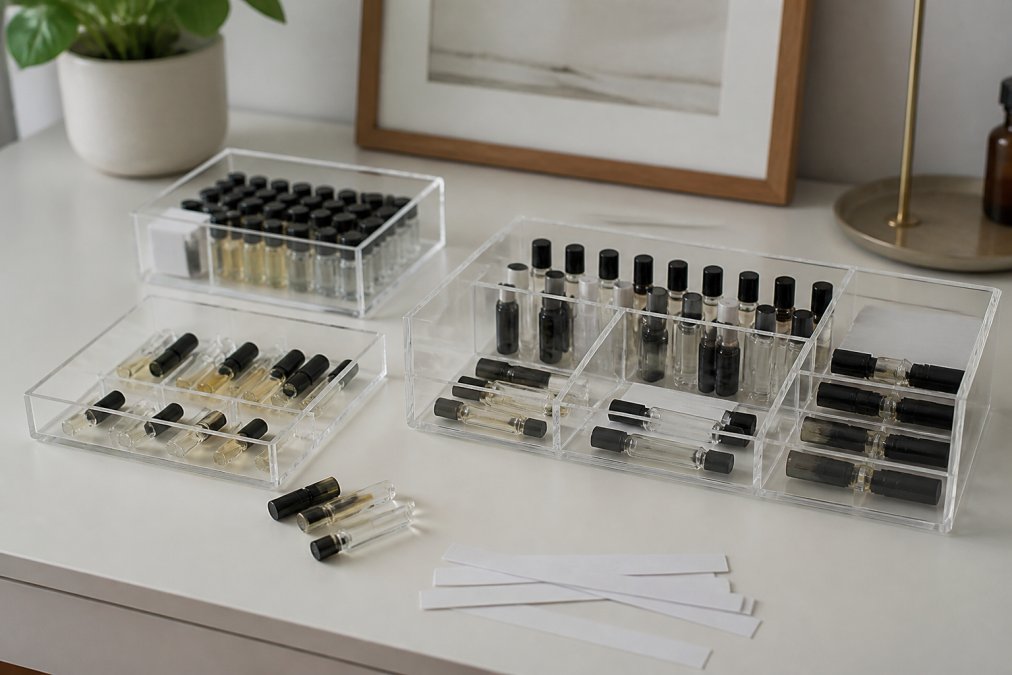
The right container depends on three things: how many vials you own, whether you want to see them, and how much light protection you need. Acrylic works for display, wood works for preservation, and drawer inserts split the difference.
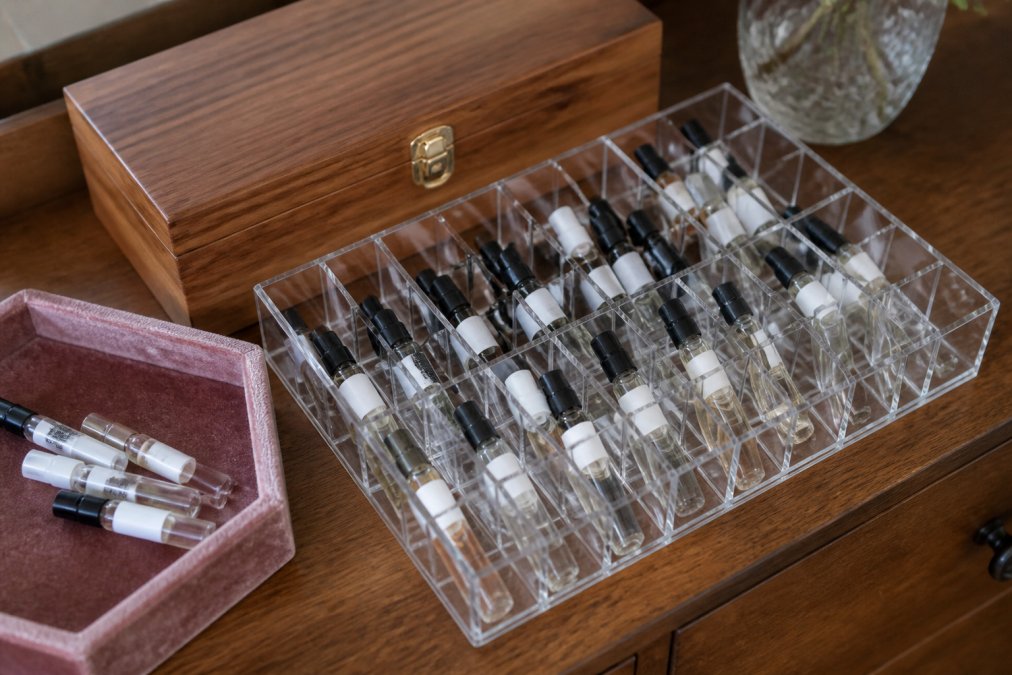
Acrylic Organizers vs. Wooden Boxes vs. Drawer Inserts
Each option solves a different problem, and the trade-offs matter more than the marketing suggests.
| Container Type | Best For | Light Protection | Typical Starting Price |
|---|---|---|---|
| Acrylic organizer (mDesign) | Seeing labels at a glance | Low | $15 |
| Wooden essential oil box | Long-term preservation | High | $30 |
| Drawer insert (IKEA GODMORGON) | Upright, tidy drawers | Medium | $12.99 |
| Acrylic lipstick organizer | Active testing rotation | Low | $8 |
| Velvet jewelry tray | Luxury drawer display | Low | $15 |
A lipstick organizer is the sleeper pick here. Its grid slots hold standard vials upright, which prevents leakage, and it costs less than most single samples. Where it falls short is capacity: it is a rotation tool, not an archive.
Step 3: Label Every Vial for Easy Identification
Labeling is the step most collectors skip, and it is the one that saves the most frustration. A vial without a label becomes anonymous within a month.
Write the scent name, the house, and the date you received it. A handheld label maker such as a Brother P-touch produces water-resistant tape that survives bathroom humidity, though you will keep buying tape refills. Handwritten labels on painter's tape work fine for smaller collections.
Perfume Storage Best Practices: Light, Temperature, and Upright Placement
Perfume storage best practices come down to three controls: block light, stabilize temperature, and keep vials upright. Heat, ultraviolet light, and oxygen are what break down a fragrance over time.
Store samples away from windows and bathroom counters, where temperature swings are worst. A closed drawer or an opaque wooden box keeps both light and heat out. Keep vials standing up so the sprayer or stopper stays clear of the liquid, which limits evaporation and leakage.
The International Fragrance Association standards set the ingredient safety framework most reputable houses follow, and those same compounds are what degrade fastest under poor storage. A $30 wooden box protects a collection worth far more than the box.
How to Make Perfume Last Longer With Proper Sample Care
Knowing how to make perfume last starts before you ever spray it. A sample stored correctly can hold its character for years, while one left on a sunny windowsill can turn within months. The difference is not luck, it is chemistry, and once you understand what is breaking down, the storage rules stop feeling arbitrary.
Why Fragrance Degrades: The Three Mechanisms
A finished fragrance is a blend of aroma compounds, a carrier (usually ethanol and water), and sometimes a fixative. Three things attack that blend:
- Oxidation. Oxygen in the headspace of a half-empty vial reacts with aroma molecules, especially citrus terpenes like limonene. Oxidized limonene does not just fade, it turns sharp, waxy, and sour. This is why a citrus sample that smelled bright on day one can smell like furniture polish six months later.
- Photodegradation. Ultraviolet light breaks carbon bonds in aroma molecules and can also degrade the dye and the carrier. This is why a clear glass vial on a sunny shelf ages faster than the same vial in a closed drawer, even at the same temperature.
- Thermal acceleration. Heat does not create new reactions, it speeds up the ones already happening. A common rule of thumb in chemistry is that reaction rates roughly double for every 10°C (18°F) rise in temperature (chem.libretexts.org). A vial stored at 80°F is degrading meaningfully faster than one stored at 70°F, and a vial in a hot car is degrading on a different timescale entirely.
Top notes, citrus, light florals, fresh aromatics, are the most volatile and the most vulnerable. Base notes like amber, musk, and woods are heavier molecules and hold up longer. This is why an aged sample often smells like the base of what it used to be.
The Storage Rules That Follow From the Chemistry
Once you know the mechanisms, the rules write themselves:
- Minimize headspace. A full vial has less oxygen to react with. If you decant, decant into the smallest container that holds what you need, and avoid transferring a sample into a larger bottle 'for convenience.'
- Block UV completely, not partially. A tinted vial helps, but an opaque box, a closed drawer, or a wooden essential-oil box blocks the light that actually does the damage. The original box is only useful if it is opaque.
- Stabilize temperature, do not chase cold. A steady 65-70°F in a dark drawer beats a refrigerator that gets opened all day. If you do refrigerate, let the vial come to room temperature before opening it, so condensation does not introduce water into the juice.
- Keep vials upright. Liquid against the seal accelerates evaporation and can degrade the gasket. Upright storage also keeps the sprayer tube clear.
- Tighten caps after every use. A loose cap is an open door for oxygen and for evaporation of the volatile top notes.
Realistic Shelf Life for Samples
Most practitioners find that a well-stored sample holds its character for two to five years, with citrus-forward scents at the shorter end and amber, woody, and musk-heavy scents at the longer end. A poorly stored sample can turn in a single summer. The variable you control is not the fragrance, it is the environment.
A $30 wooden box protects a collection worth far more than the box. The International Fragrance Association standards set the ingredient safety framework most reputable houses follow, and those same aroma compounds are what degrade fastest under poor storage.
Build a Fragrance Inventory Tracker for Your Collection
A fragrance inventory tracker is a record of every sample you own, what it smells like, and how long it lasts on your skin. It is the single most useful tool for a growing collection, because memory fails long before the vials run out.
Digital vs. Paper Tracking Methods
Paper journals suit collectors who enjoy the ritual. A dedicated logbook like The Perfume Journal gives you structured sections for notes and longevity, plus alphabetical indexing, though every entry is manual.
Digital tracking wins on searchability. A simple spreadsheet with columns for name, house, family, notes, date acquired, and longevity rating lets you filter instantly. Add a photo column and you can identify a vial from your phone while standing in a store.
| Tracking Method | Best For | Effort | Searchable |
|---|---|---|---|
| Paper journal | Ritual and reflection | High per entry | No |
| Spreadsheet | Large collections | Low after setup | Yes |
| Notes app | Quick capture on the go | Very low | Partial |
| Photo album | Visual reference | Low | Partial |
Whichever method you pick, log the scent within a day of testing it. Notes fade from memory faster than the fragrance fades from the vial.
Organizing Samples for Travel and Display
Travel and display pull in opposite directions. Travel demands leak-proof containment and compact size; display demands visibility and beauty. Most guides treat travel as an afterthought, a zip bag and a prayer, but a portable sample kit is its own system, and it is the one part of your collection that leaves the house.
Build a Leak-Proof Travel Kit
The failure mode in transit is not breakage, it is pressure. Cabin altitude changes push liquid past a loose sprayer or stopper, and a single weeping vial can scent an entire bag. Three controls prevent it:
- Decant into a travel atomizer, not the original vial. A 5 mL or 10 mL refillable atomizer with a screw-on collar seals tighter than a crimped sample sprayer. Fill it only three-quarters full so the liquid has room to expand.
- Stand vials upright inside a rigid insert. Foam, velvet, or a molded EVA tray holds each vial in its own slot so nothing clinks or tips. A soft pouch lets vials lie sideways, which puts liquid against the seal.
- Double-bag the whole kit. A quart-size zip-top bag inside a second bag contains any leak that does happen. This also satisfies the 3-1-1 liquids rule for carry-on: containers of 3.4 ounces (100 mL) or less, all fitting in one quart-size clear bag, one bag per passenger.
A hard-shell case sized for lipsticks or essential oils works well because the slots are already the right diameter for standard 1-2 mL vials. Look for a case with a gasket or a snap latch rather than a zipper alone, zippers relax with use.
What to Pack and What to Leave
Pack a travel rotation of 4-6 scents, not your archive. Choose one fresh citrus or aquatic for daytime heat, one woody or amber for evening, and one or two wildcards. Decant only what you will use in the trip window; a 5 mL atomizer holds roughly 50-75 sprays, which is more than a week of daily wear.
Leave full-size glass at home, and never pack it in a checked bag, cabin pressure and baggage handling are both harder on glass than a carry-on ever is. If you must check a fragrance, wrap it in clothing, seal it in a bag, and accept that the risk is real.
Display Without Degrading
Display is a trade-off, not a free win. Ultraviolet light and heat are the two fastest degraders of a fragrance, so anything on open display is aging faster than anything in a drawer. The fix is rotation: keep a curated group of 6-10 vials on the vanity or in an acrylic organizer, and store the rest in an opaque box or a closed drawer.
A velvet tray inside a drawer gives you the finished look of a display with the light protection of storage. An acrylic organizer on a vanity gives you the visibility of display with the light exposure that comes with it, acceptable for a rotation you will cycle through in a month, not for an archive you plan to keep for years.
Rotate the display monthly. It keeps the collection visually fresh, spreads wear across your samples, and limits how long any single vial sits in light.
Frequently Asked Questions
Do perfume samples go bad if not stored correctly?
Yes. Fragrance samples degrade faster than full bottles because small vials expose more liquid to air and light. Heat, humidity, and direct sunlight break down the top notes first, so a sample that smelled bright when you got it can turn sharp or flat within months. Keep vials upright, away from bathroom steam, and inside a closed drawer or opaque box. A properly stored sample can stay true for one to two years.
What is the best way to label fragrance samples for easy identification?
Use a label maker with water-resistant tape, or write on painter's tape with a fine-tip marker. Include the fragrance name, brand, and the date you received it. If you are tracking notes, add a short code like 'F' for floral or 'W' for woody. Place the label on the vial's body, not the cap, so it stays readable when the cap is off. This simple step prevents you from re-testing scents you already know you dislike.
How can I track which fragrance samples I have already tried?
Start a fragrance inventory tracker, either a notebook like The Perfume Journal or a simple spreadsheet. Log each sample's name, brand, date tested, and a one-line impression. Rate longevity and sillage on a 1-5 scale. A digital tracker lets you sort by fragrance family or season, so you can quickly pull up your favorite warm-weather scents. This record also stops you from buying a full bottle of something you already sampled and forgot.
Should perfume samples be kept in the dark?
Yes. Ultraviolet light from windows and some indoor bulbs accelerates the breakdown of fragrance molecules, especially citrus and floral notes. Store your samples in an opaque wooden box, a closed drawer, or a tinted container. If you prefer a clear acrylic organizer for display, keep it inside a cabinet rather than on an open shelf. Limiting light exposure is one of the simplest ways to extend the shelf life of every vial in your collection.