
How Long Do Perfume Samples Last? Storage & Use
Table of Contents
- The Real Answer: How Long Do Perfume Samples Last?
- How Many Sprays in a 2ml Perfume Sample?
- Key Factors That Determine How Long a Sample Lasts
- How to Store Perfume Samples to Maximize Shelf Life
- Signs of Spoiled Perfume: When to Throw a Sample Away
- How to Make a Perfume Sample Last Longer on Your Skin
- Conclusion
- Frequently Asked Questions
Last Updated: September 5, 2026
The Real Answer: How Long Do Perfume Samples Last?
A 1ml to 2ml perfume sample typically provides scent for 3 to 7 days of daily wear, but the vial itself can remain viable for years when stored correctly. The distinction matters because most people confuse how long the liquid lasts with how long the fragrance remains fresh.
Perfume samples are small alcohol-based or oil-based solutions containing fragrance concentration that degrades over time through oxidation. The usable lifespan of the sample itself depends entirely on storage conditions, not the size of the vial.
Here is the tension most guides miss: the sample's shelf life and its usage duration are two completely different numbers. The vial lasts years. The liquid inside lasts days of actual wear.
How Many Sprays in a 2ml Perfume Sample?
A standard 2ml perfume sample delivers roughly 20 to 30 sprays, which translates to about 5 to 7 days of use when applying twice daily. This calculation assumes a typical atomizer that releases approximately 0.07ml to 0.1ml per spray, a figure that varies significantly by bottle design.
The math is straightforward once you know your spray volume. Most fragrance samples use one of two delivery methods, and the difference changes your usage estimate by nearly half.
Atomizer vs. Dabber Efficiency
Atomizer samples spray a fine mist that distributes evenly across the skin, allowing you to cover more surface area with less liquid. A single spray from an atomizer typically covers the wrist and inner elbow, making it the more economical choice for testing a scent's full profile.
Dabber vials, by contrast, require you to roll or press the applicator directly against your skin. This method deposits a heavier, more concentrated layer of liquid in a smaller area. You will use more product per application, but the scent intensity may actually read stronger initially because the concentration is localized rather than dispersed.
The Real Math: Sprays, Drops, and Wears
The delivery mechanism dictates more than just feel, it determines how many wears you actually get. Here is the breakdown for a 2ml sample:
| Delivery Method | Typical Volume per Application | Total Applications (2ml) | Estimated Wears (2x daily) |
|---|---|---|---|
| Fine-mist atomizer | 0.07-0.1ml per spray | 20-28 sprays | 10-14 wears |
| Standard atomizer | 0.1-0.12ml per spray | 16-20 sprays | 8-10 wears |
| Dabber vial | 0.15-0.2ml per roll | 10-13 applications | 5-7 wears |
Why Spray Count Varies by Brand
Not all atomizers are created equal. A 2ml sample from one house may deliver 30 fine mists, while another brand's crimped vial produces 18 heavier sprays. The difference comes down to the actuator design, the small plastic nozzle that controls flow rate and droplet size.
The 1ml vs. 2ml vs. 5ml Reality
Sample sizes are not standardized across the industry. A 1ml vial is often a dabber and yields only 5-8 applications. A 2ml atomizer is the sweet spot for evaluation. A 5ml travel spray, increasingly common in discovery sets, delivers 50-70 sprays and can last two full weeks of daily wear. When comparing prices per wear, the 5ml format is almost always the better value, but only if you actually finish it.
The Hidden Cost of Overspraying
Most people overspray samples because they are unsure how much is enough. A single spray from an atomizer covers the wrist and inner elbow. Two sprays, one to the chest, one to the neck, are sufficient for most daytime wear. Three or more sprays on a 2ml sample will cut your total wears by a third or more.
What This Means for Your Purchase Decision
If a sample lasts you 3 days instead of 7, the problem is rarely the sample, it is the application method. Switching from a dabber to an atomizer, or simply counting your sprays, can double the number of wears you get from the same vial.
Key Factors That Determine How Long a Sample Lasts
Your daily application frequency is the single largest variable in how long perfume samples last. Two people with identical 2ml vials will finish them at completely different rates based on how often they reapply, how many pulse points they target, and whether they layer the scent over unscented lotion.
The fragrance structure itself plays a role in perceived longevity. Top notes, the bright citrus and herbal opening, evaporate within 15 to 30 minutes. Base notes, the deeper woods, musks, and resins, can linger for six to eight hours on skin.
Skin chemistry and absorption rates also matter more than most people expect. Dry skin holds fragrance for a shorter period because there is less natural oil to anchor the scent molecules.
How to Store Perfume Samples to Maximize Shelf Life
Store perfume samples in a cool, dark place between 60 and 70 degrees Fahrenheit, away from direct sunlight and temperature fluctuations. The bathroom cabinet is the worst location because humidity and heat cycling accelerate fragrance degradation faster than almost any other factor.
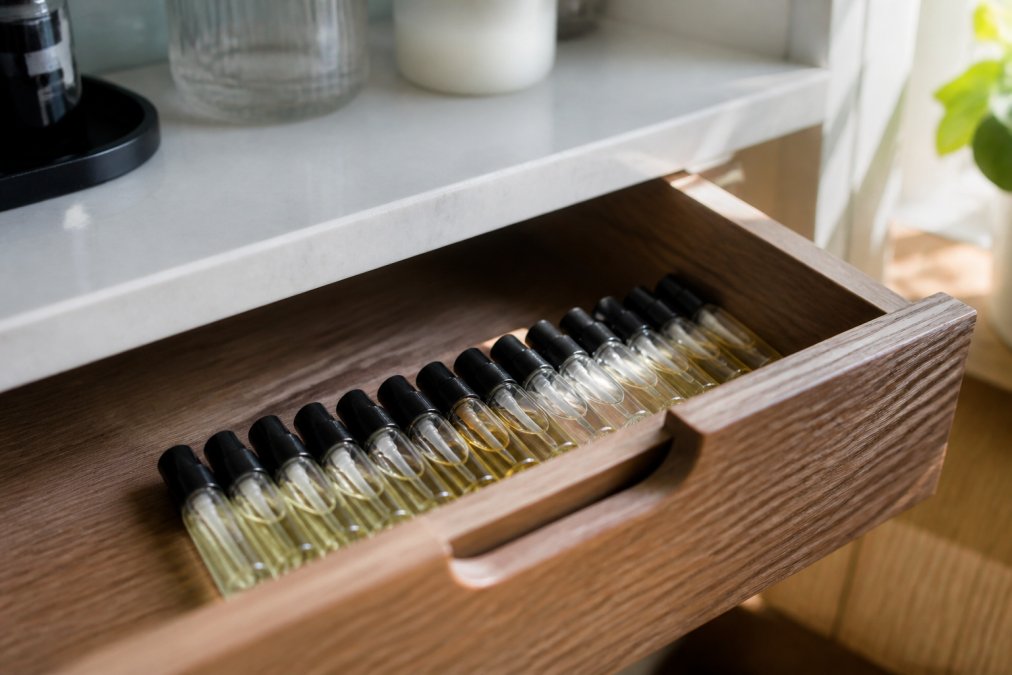
The three primary enemies of fragrance are light, heat, and oxygen. Ultraviolet rays break down the molecular bonds in fragrance notes, heat accelerates evaporation and oxidation, and repeated exposure to air degrades the scent profile.
The Chemistry of Degradation: What Actually Goes Wrong
Fragrance degradation is not a single event, it is a cascade of chemical reactions. When UV light hits a perfume sample, it triggers photolysis, breaking down the large aromatic molecules that carry the scent into smaller, often sour-smelling compounds. Heat accelerates this process by increasing molecular kinetic energy, which speeds up both evaporation of the volatile top notes and oxidation of the alcohol carrier.
This is why a sample stored in a hot car for a week can smell noticeably different from the same batch kept in a drawer. The degradation is not linear, it compounds.
Container Material: Glass vs. Plastic vs. Metal
The vial itself is a storage decision. Glass is the gold standard because it is chemically inert and does not interact with the fragrance. Plastic vials, especially those made from low-density polyethylene, can absorb fragrance molecules over time and may leach trace plasticizers into the liquid. Metal crimps on glass vials are generally safe, but if the crimp corrodes, visible as a white or greenish residue, the fragrance has been compromised.
The Air Gap Problem: Why Partially Used Samples Die Faster
A full, sealed sample has minimal air inside. Once you open it and use half, the air space above the liquid doubles or triples. That air contains oxygen, which begins oxidizing the remaining fragrance immediately. The solution is simple: transfer partially used samples into smaller vials, or squeeze out excess air before resealing if the vial is flexible.
Travel and Temperature Fluctuations: The Overlooked Risk
Carrying samples in a purse or backpack is the most common use case, yet it is also the most destructive. A sample in a bag experiences constant temperature swings, from air-conditioned offices to hot cars to humid outdoor air. Each cycle accelerates the degradation process. If you carry samples regularly, keep them in a small insulated pouch or a dedicated compartment away from direct body heat.
The 12-Month Rule for Opened Samples
Most practitioners find that an opened sample retains its intended scent profile for 6 to 12 months when stored properly. After that, the top notes fade first, followed by a gradual flattening of the heart notes. Base notes, woods, musks, resins, are the most resilient and may remain recognizable for two to three years.
Storage Checklist for Maximum Shelf Life
| Storage Factor | Ideal Condition | Impact of Getting It Wrong |
|---|---|---|
| Temperature | 60-70°F, consistent | Heat accelerates evaporation and oxidation |
| Light exposure | Complete darkness | UV rays break down fragrance notes |
| Container seal | Airtight, upright | Air exposure degrades the scent profile |
| Humidity | Low, dry environment | Moisture can alter the alcohol balance |
| Container material | Glass preferred | Plastic may absorb or leach over time |
| Headspace | Minimal air above liquid | Oxygen oxidizes remaining fragrance |
Keep samples upright to prevent the liquid from contacting the vial's crimp or seal, which can degrade over time. Transferring a sample to a smaller container once it is partially used also reduces the air space above the liquid, slowing oxidation. The International Fragrance Association guidance on fragrance stability emphasizes that consistent temperature control is the most effective preservation method for alcohol-based compositions.
Signs of Spoiled Perfume: When to Throw a Sample Away
A spoiled perfume sample typically announces itself through a changed scent profile, darkened color, or visible sediment. The most reliable indicator is smell: if the fragrance has turned sharp, sour, or noticeably weaker than you remember, oxidation has already altered its composition.
Color changes are easier to spot in clear vials. Fresh perfume is usually pale yellow to amber depending on the notes. A sample that deepens significantly or develops a brownish tint has been exposed to heat or light for too long.
Batch codes and expiration dates offer limited guidance for samples because most vials arrive undated. The FDA guidance on cosmetic product dating notes that manufacturers are not required to print expiration dates on fragrance products, so sensory evaluation becomes your primary tool. When in doubt, trust your nose and discard the sample rather than risk applying a degraded product.
How to Make a Perfume Sample Last Longer on Your Skin
Apply your sample immediately after showering while skin is still slightly damp, then lock in the scent with an unscented moisturizer. This two-step approach gives the fragrance a hydrated base that slows evaporation and extends wear time by several hours.
Target your pulse points where blood vessels sit close to the skin's surface. The inside of the wrists, the base of the throat, and behind the ears radiate heat that helps project the fragrance without requiring heavy reapplication.
For a 2ml sample, plan your applications strategically. One spray to the chest and one to the neck covers most daily wear. If you are testing a scent for a full day to evaluate its longevity and sillage, apply once in the morning and once after lunch rather than layering multiple sprays at once.
The American Chemical Society's research on fragrance evaporation confirms that fragrance longevity on skin depends more on application technique and skin preparation than on the quantity applied. A single well-placed spray on moisturized skin outperforms three sprays on dry skin every time.
Conclusion
Understanding how long perfume samples last comes down to separating two timelines: the days of wear you get from the liquid and the years of freshness you preserve through proper storage. Most people waste samples through poor storage or inefficient application, not because the samples themselves are inadequate.
Ruth+Bo discovery sets are designed around this reality. Each sample is sized for genuine evaluation across multiple wears, letting you experience how a fragrance evolves from top notes through the dry-down before committing to a full bottle. The story-driven collections let you test scents in real conditions, on your skin, over several days.
Get started with Ruth+Bo and find the fragrance that lasts as long as the story behind it.
Frequently Asked Questions
Is a 7 year old perfume still good?
Most likely not. While unopened, properly stored fragrances can last several years, a 7-year-old opened bottle or sample has had significant exposure to oxygen and light. The alcohol base may have evaporated and the fragrance oils oxidized, which changes the scent profile. If it smells sharp, sour, or nothing like the original, it has spoiled. For samples, it's better to use them within 6 to 12 months of opening for the truest experience.
How do I know if a perfume sample has gone bad?
Check for three main signs of spoiled perfume. First, a scent change: if the top notes smell flat, metallic, or like vinegar, oxidation has occurred. Second, a color change: if a clear liquid has turned yellow or brown, it's degraded. Third, a texture change: any stickiness or residue in the vial. If the liquid has visibly decreased, evaporation happened. When any of these appear, it's time to discard the sample.
How can I make a 2ml perfume sample last longer?
To extend the fragrance's life on your skin, apply it to pulse points right after a shower when your skin is warm and hydrated, but avoid rubbing your wrists together as this crushes the scent molecules. Use an unscented moisturizer first to help the fragrance cling to your skin. To extend the sample's shelf life, store the vial upright in a cool, dark place and minimize air exposure by keeping the cap tightly sealed when not in use.
This article was written using GrandRanker