
Best Faith-Inspired Perfumes for Him: 2026 Guide
Table of Contents
- Quick Comparison: Best Faith-Inspired Perfumes for Him
- How to Choose a Faith-Based Fragrance
- The Benefits of Story-Driven Scents
- Ruth+Bo Fragrance Discovery Sets: Try Before You Commit
- Other Faith-Inspired Perfumes Worth Knowing
- Scent Layering and Ingredient Transparency: What Most Guides Skip
- Allergy and Sensitivity Considerations for Faith-Inspired Fragrances
- Conclusion
- Frequently Asked Questions
Last Updated: September 10, 2026
Quick Comparison: Best Faith-Inspired Perfumes for Him
Faith-inspired perfumes are fragrances built around the aromatic substances named in scripture, including frankincense, myrrh, spikenard, and cedarwood, and composed to evoke devotion rather than trend.
Here is the short version before the detail.
| Fragrance | Starting Price | Dominant Notes | Best For |
|---|---|---|---|
| Ruth+Bo discovery sets | See site for current pricing | Varies by set | Testing before committing |
| Imaginary Authors City on Fire | $105 | Cade oil, burning wood, berries | Bold, smoky statement wear |
| Bvlgari Man Wood Neroli | $120 | Neroli, cedarwood, white musk | Everyday professional wear |
| Diptyque Fleur de Peau | $225 | Iris, ambrette, musk | Subtle, close-to-skin wear |
| Clive Christian Art Deco Cypress | $300+ | Woody aromatic, cypress | Collectors and formal occasions |
Research into how scent interacts with memory and emotion continues to shape how perfumers build these compositions, and the Sense of Smell Institute research library remains a useful starting point for understanding why resinous and woody notes carry such weight in devotional contexts.
How to Choose a Faith-Based Fragrance
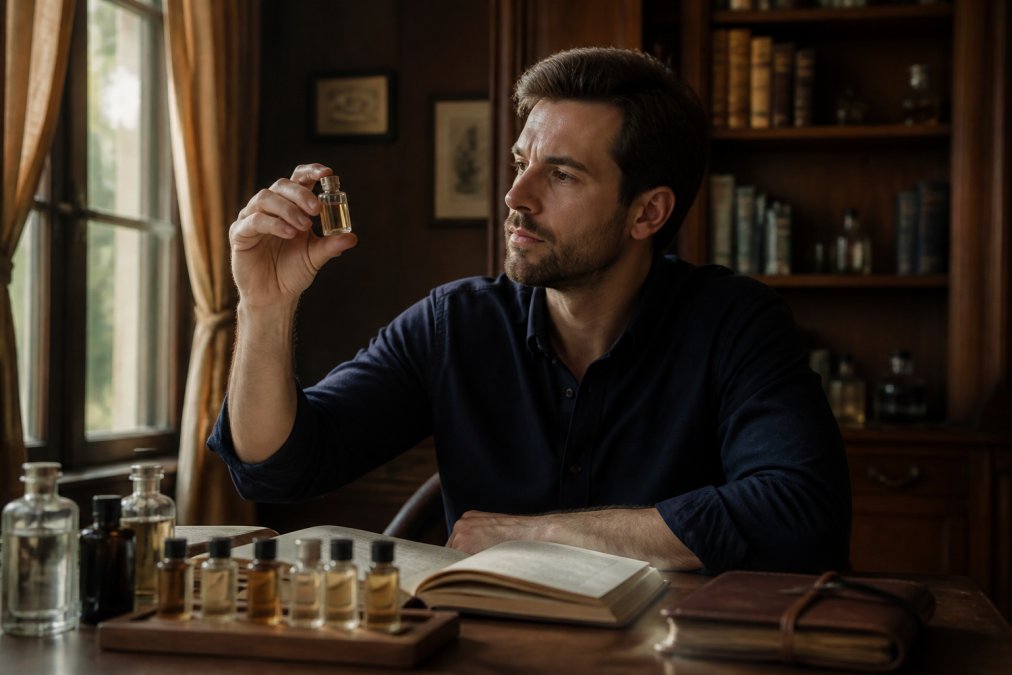
Choosing a faith-based fragrance starts with the notes that carry meaning for you, then narrowing by occasion and skin chemistry.
Start With the Notes That Carry Meaning
Frankincense and myrrh are the two resins most associated with sacred tradition, and both read as dry, balsamic, and slightly citrus-edged in modern compositions. Cedarwood and spikenard pull in a woodier, earthier direction.
A practical sequence:
- Identify two notes from scripture that appeal to you
- Sample fragrances built on those notes rather than around them
- Wear each sample for a full day before judging
- Note how the scent evolves after the first hour
Match the Scent to the Occasion
A resinous incense composition suits evening and formal settings. Cleaner woody-aromatic profiles work better for the office.
- Worship and formal events: frankincense, myrrh, incense accords
- Daily office wear: cedarwood, neroli, light musk
- Evening and intimate settings: spikenard, amber, deep resins
- Warm weather: citrus-forward interpretations of biblical notes
The Benefits of Story-Driven Scents
Most guides stop at "a fragrance with meaning feels better to wear." That is true but useless on its own. The practical case for a story-driven scent comes down to three mechanisms you can actually test on yourself.
Scent and Memory: Why the Story Sticks
Smell is routed through the olfactory bulb, which sits close to the amygdala and hippocampus, the regions tied to emotion and memory (the NIH). That is why a specific resin can pull up a specific room, a specific service, a specific person. When a fragrance is built around a narrative you already hold (a psalm, a pilgrimage, a family tradition), the scent has something to attach to. A designer bottle built on a trend has nothing to attach to, which is why it fades from your memory even when it performs well on skin.
Wear Frequency and Signature Building
A fragrance you reach for consistently becomes a signature. A fragrance you bought on a whim becomes a bottle that sits at the back of the shelf. The difference is usually not the juice, it is whether the wearer has a reason to choose it on a Tuesday morning.
Story-driven scents solve that problem by giving you a decision rule. If the scent is tied to quiet reflection, you wear it on quiet days. If it is tied to celebration, you wear it to weddings and ordinations. The narrative does the choosing for you, which is why these bottles tend to get emptied rather than abandoned.
Gifting: Why the Story Does Half the Work
For gift-givers, a faith-inspired fragrance is easier to match than a designer bottle because the narrative narrows the field. You are not guessing whether he prefers aquatic or gourmand, you are choosing between resins, woods, and incense accords, and you can anchor the choice to something he already cares about.
Three gift scenarios where this matters most:
- Baptism, confirmation, or ordination: a resinous frankincense or myrrh composition reads as a marker of the occasion rather than a generic present.
- Anniversary or wedding: a paired set, one masculine, one feminine, built around the same resin, turns the gift into a shared object rather than two separate bottles.
- Father's Day or a milestone birthday: a discovery set lets him find his own signature, which is often a better gift than a full bottle chosen on his behalf.
The Honest Trade-Off
Story-driven scents are not automatically better fragrances. Some are built on a strong narrative and a weak composition, and the story cannot rescue a scent that turns sharp or disappears in an hour. The narrative is a reason to sample, not a reason to buy blind. Treat the story as the entry point and the drydown as the verdict.
Ruth+Bo Fragrance Discovery Sets: Try Before You Commit
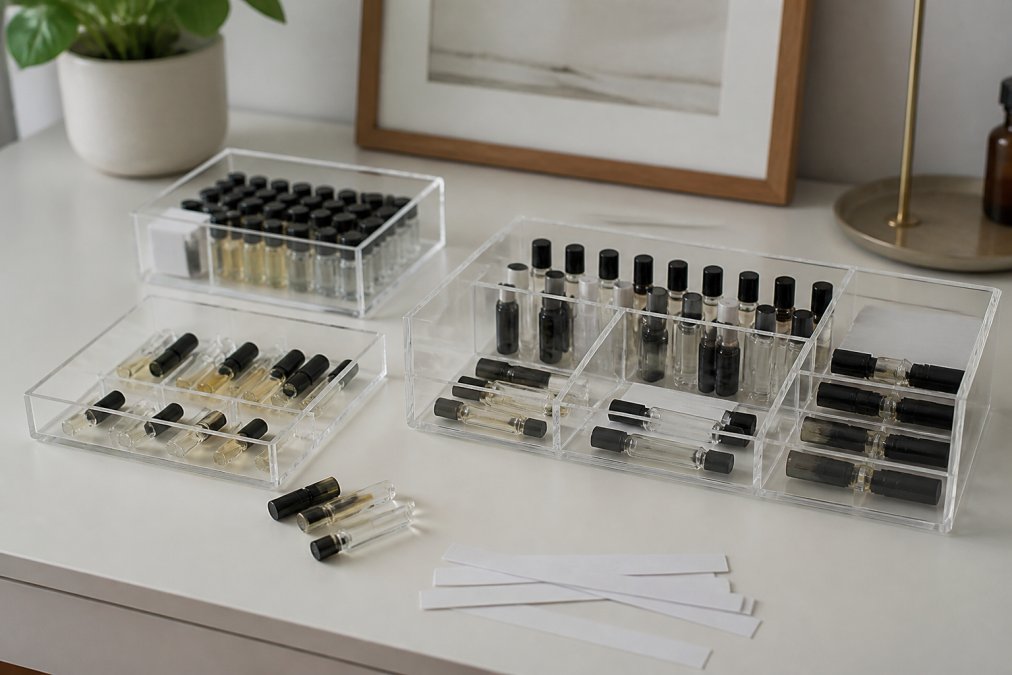
Ruth+Bo builds modern fragrances for men and women around faith-rooted narratives, and the discovery sets exist precisely because skin chemistry decides everything. Sampling is the only honest way to know whether a resinous composition will bloom or turn sharp on you.
The sets let you work through several scents in your own time rather than judging from a department store strip. For anyone drawn to the idea of a faith-inspired fragrance but unsure where to start, this is the lowest-risk entry point.
Ruth+Bo also offers thematic gift sets with paired scents, which suit couples and make a considered present for weddings or anniversaries. The house runs curated masculine and feminine collections. Current pricing and set contents are listed on the Ruth+Bo site.
Other Faith-Inspired Perfumes Worth Knowing
Several established houses produce compositions that sit comfortably in this space, even when they are not marketed as faith-based. The four below are worth sampling alongside a dedicated discovery set, and each occupies a different point on the smoky-to-clean spectrum.
Imaginary Authors City on Fire
City on Fire leans hard into the church-vibe territory with cade oil, burning wood, and berries. It is an eau de parfum with real staying power, and it is genuinely polarizing.
Buy it if you want a scent that announces itself. Skip it if you work in a close office.

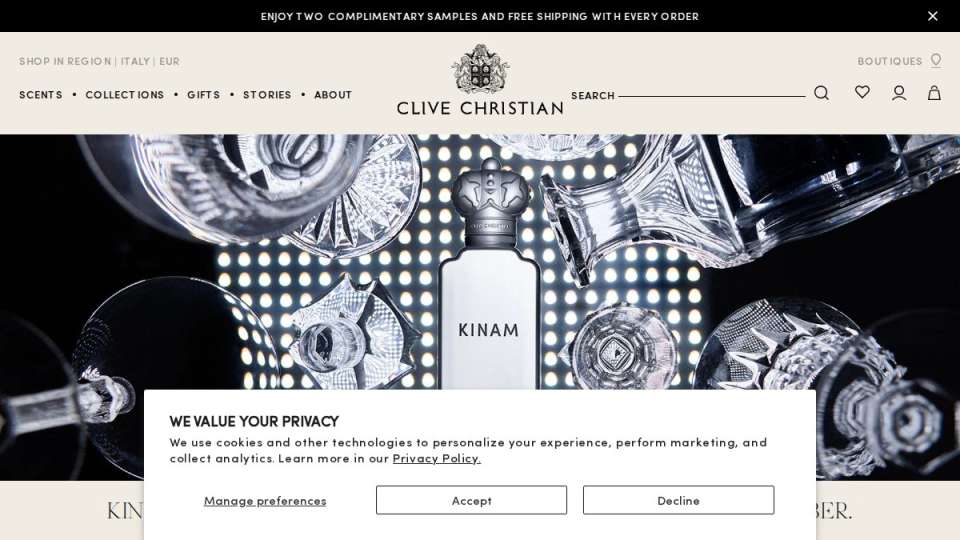
Clive Christian Art Deco Cypress
A luxury house composition with a complex woody-aromatic structure and rare ingredient sourcing. The presentation is as considered as the juice, and complimentary samples are often included with orders.
The price is the barrier. At $300 and up, this is a collector's purchase rather than an everyday bottle.
Bvlgari Man Wood Neroli
Neroli, cedarwood, and white musk make this the most versatile option here. It reads clean, earthy, and meditative without tipping into incense territory.
Performance is reliable and the scent is hard to dislike, which makes it a safe daily wear. It is less niche than a boutique faith-inspired house, and that is the trade-off.
Diptyque Fleur de Peau
A musk-forward composition with iris and ambrette that sits close to the skin. If you want something contemplative and intimate rather than projection-heavy, this is the pick.
The lower projection is the honest limitation. Some wearers want more presence than this delivers.
Scent Layering and Ingredient Transparency: What Most Guides Skip
Most faith-inspired fragrance guides treat the bottle as the finished product. Two things they almost never cover: how to layer scents as part of a devotional or meditative practice, and how to find out what is actually inside the bottle. Both are worth understanding before you spend on a full-size.
Layering as a Practice, Not a Trick
Layering is usually sold as a way to boost performance. For faith-inspired wearers, it can also function as a ritual, a short, repeatable sequence that marks the transition into prayer, study, or quiet reflection. The mechanics are simple, but the order matters.
A workable sequence:
- Start with the base. Apply the heavier, darker scent first, a resinous frankincense, myrrh, or spikenard composition. Give it two to three minutes to settle.
- Add the lighter layer. Apply a woody-aromatic or citrus-forward scent over it, on the same pulse points or slightly offset (wrists and throat, for example).
- Keep the ratio weighted toward the base. A common starting point is roughly two parts base to one part top layer. Reversing that ratio is the fastest way to get a muddy result.
- Stop at two. Three or more scents rarely resolve into anything readable.
Where this becomes a practice rather than a performance hack: pick a fixed pairing for a fixed context. The same base-and-top combination every time you sit down to read, pray, or journal. Over a few weeks the pairing becomes a cue, the scent itself starts to signal the transition, the way a specific room or a specific chair does.
What to Ask Before You Buy
"Biblical ingredients" is a marketing phrase, not a sourcing claim. Frankincense, myrrh, and spikenard are agricultural products with real supply chains, and the difference between a $40 bottle and a $300 bottle is often the grade and origin of the resin rather than the perfumer's skill.
The International Fragrance Association standards set the compliance framework most serious houses follow, and asking a brand whether its formulas meet those standards is a fair question. Beyond compliance, four questions separate a transparent house from a vague one:
- Where does the resin come from? Frankincense is typically sourced from trees in the Boswellia genus, and myrrh from Commiphora. Origin affects both scent profile and the ethics of the supply chain.
- Is the ingredient listed as an absolute, an essential oil, or a reconstitution? A natural absolute and a lab-built accord can smell similar on a test strip but behave very differently on skin and in price.
- Does the brand publish a full ingredient list on request? A house that will not share one is telling you something.
- Is the formula IFRA-compliant? This matters most if you have sensitive skin or wear fragrance daily.
The Sourcing Trade-Off, Stated Plainly
Natural absolutes and essential oils vary batch to batch, which is part of their appeal and part of their cost. Synthetic accords are consistent, cheaper, and often more stable on skin. Neither is automatically better, but you should know which one you are paying for, especially at the top of the price range.
Allergy and Sensitivity Considerations for Faith-Inspired Fragrances
Fragrance sensitivity is common, and resin-heavy compositions are not exempt. Patch-test any new scent on the inner forearm and wait 24 hours before wearing it on the neck or chest.
If you have reacted to fragrances before, note which note families triggered it. Citrus and floral accords cause most reactions, but individual responses vary widely. Alcohol-based eau de parfum can also irritate dry or broken skin, so apply to intact skin only.
For anyone with a diagnosed sensitivity, consult a dermatologist before introducing a new fragrance, and ask the brand for a full ingredient list rather than relying on the top-note description.
Conclusion
Finding a faith-inspired fragrance that actually suits you takes sampling, not guesswork, and the field rewards patience. Ruth+Bo offers story-driven masculine and feminine collections, discovery sets that let you test before committing, and thematic gift sets with paired scents for couples and special occasions. Start with a discovery set, wear each sample for a full day, and let your skin decide.
Frequently Asked Questions
What makes a fragrance faith-inspired?
A faith-inspired perfume ties its scent profile to a spiritual narrative, often drawing on biblical aromatics like frankincense, myrrh, spikenard, and cedarwood. The story behind the scent matters as much as the notes. Brands like Ruth+Bo build each fragrance around a specific passage or theme, so the wearer connects the scent to something meaningful. It is not about a single ingredient, but about intention, heritage, and the narrative the perfumer chooses to tell.
What ingredients are commonly found in scripture-inspired colognes?
Frankincense and myrrh are the most recognized, both resinous and woody. Spikenard, cedarwood, cassia, and galbanum also appear in biblical texts and show up in modern interpretations. Many faith-inspired perfumes pair these base notes with lighter top notes like neroli or citrus so the scent works for daily wear. The result is a fragrance that feels ancient in character but wearable in a modern setting.
How do I choose a faith-based fragrance that suits my skin chemistry?
Start with a discovery set rather than a full bottle. Skin chemistry changes how a fragrance develops, so a scent that smells one way on paper can shift on your skin within 30 minutes. Apply to pulse points, wait at least an hour, and note how the base notes settle. Ruth+Bo discovery sets let you test multiple scents before committing to a full size, which removes most of the guesswork from buying online.
Are faith-inspired perfumes long-lasting enough for all-day wear?
Performance depends on concentration and base notes. Eau de parfum formulations with resinous or woody base notes like frankincense, myrrh, and cedarwood typically last six to eight hours on skin. Lighter compositions with citrus or neroli top notes fade faster. Applying to moisturized skin and pulse points extends wear. If longevity matters most, look for scents built on resinous or woody foundations rather than fresh, citrus-forward profiles.
Can I wear a faith-inspired fragrance every day, or is it only for special occasions?
Most faith-inspired perfumes work for everyday wear. The key is choosing a scent profile that matches your environment. A clean, meditative fragrance with cedarwood and white musk suits an office or casual setting. A heavier, smoky incense-forward scent works better for evenings or cooler months. Many men build a small fragrance wardrobe with two or three options and rotate based on the occasion.
Choosing a fragrance you will still want to wear in five years means starting with samples rather than a full bottle. Ruth+Bo offers curated masculine and feminine collections, discovery sets for low-risk testing, and thematic gift sets featuring paired scents for weddings, anniversaries, and holidays. Get started with Ruth+Bo and find the scent that fits both your story and your skin.