
Perfume Application Tips for Sensitive Skin
Table of Contents
- Perfume Application Tips for Sensitive Skin: What Changes
- How to Test Perfume for Skin Allergies Before You Commit
- Fragrance Ingredients to Avoid for Sensitive Skin
- Applying Perfume to Clothing vs Skin: Which Is Safer?
- Step-by-Step: Where and How to Apply Perfume on Reactive Skin
- What to Do If a Reaction Occurs
- Building a Personalized Application Plan That Lasts
- Frequently Asked Questions
Last Updated: October 6, 2026
Perfume Application Tips for Sensitive Skin: What Changes
Perfume application tips for sensitive skin start with one rule: treat every new scent like a patch test waiting to happen. If your skin stings, reddens, or itches after fragrance, you are not imagining it. Reactive skin needs a slower approach than spritz-and-go advice.
This guide from Ruth+Bo walks through testing, ingredient checks, and a step-by-step application method built for skin that reacts. The American Academy of Dermatology's guidance on fragrance reactions notes that fragrance is one of the most common causes of allergic contact dermatitis, which is why a testing habit matters more than a perfect scent choice.
How to Test Perfume for Skin Allergies Before You Commit
The only reliable way to test perfume for skin allergies is a patch test on a small area, repeated over two days. A quick wrist sniff tells you nothing about how your skin responds hours later.
The 48-Hour Patch Test Protocol
Follow these steps before wearing any new scent on a full application area:
- Clean the test spot. Use the inner forearm, not the wrist. Wash with unscented soap and let it dry.
- Apply a small amount. Dab one drop of perfume on a coin-sized area. Do not rub it in.
- Wait 24 hours. Leave the spot alone. Do not wash it, cover it, or add other products.
- Check for a reaction. Look for redness, bumps, itching, or swelling. If nothing appears, reapply.
- Wait another 24 hours. Check again. Delayed reactions often show up on day two, not day one.
- Record the result. Note the scent name and your reaction in a notes app or journal.
If both checks come back clear, you can move to a normal application. If either shows a reaction, stop and do not wear that scent.
Fragrance Allergy vs. Irritation: How to Tell Them Apart
Fragrance allergy is an immune response that can worsen with each exposure; irritation is direct damage to the skin surface that clears once you stop using the product.
- Allergy signs: itching, redness, small bumps, swelling, sometimes spreading beyond the application spot
- Irritation signs: stinging, burning, dryness, or flaking right where you applied it
- Timing: allergies often appear 12 to 48 hours later; irritation shows up fast
If you suspect a true allergy, see a dermatologist. They can run patch testing to identify which specific ingredients trigger your skin.
Fragrance Ingredients to Avoid for Sensitive Skin
Certain ingredients show up again and again in fragrance reactions. Checking the label before you buy saves discomfort, but only if you know what you are looking at.
The Two Mechanisms Behind Most Reactions
Fragrance problems usually come down to two pathways:
- Irritant contact dermatitis, the ingredient directly damages the skin barrier. It stings or burns quickly, stays roughly the same with repeat use, and clears once you stop.
- Allergic contact dermatitis, the immune system flags the ingredient as a threat. It often appears 12 to 48 hours later, can spread beyond the application spot, and tends to worsen with each new exposure.
An ingredient that only irritates at high concentration may be tolerable diluted, while a true allergen should be avoided entirely, even in tiny amounts.
Common Triggers and Why They React
- Synthetic musks like galaxolide and tonalide, large molecules that linger on skin and resist washing off, which extends exposure time.
- Cinnamal and cinnamic alcohol, oxidation products form as the scent ages, and those breakdown molecules are more reactive than the original.
- Eugenol and isoeugenol, common in clove and carnation notes; both are on the published fragrance allergen lists used by dermatologists.
Natural does not mean safe. Many essential oils trigger reactions as often as lab-made molecules, and some, like citrus oils, are phototoxic, reacting when treated skin meets sunlight.
Why the Label Often Does Not Help
The FDA's page on fragrance in cosmetics explains that the single word "fragrance" or "parfum" on an ingredient list can legally stand in for a blend of dozens of individual compounds. That means a bottle can list "fragrance" and never name the specific allergen your skin reacts to.
A few practical workarounds:
- Look for brands that publish full component lists rather than the catch-all term.
- Check for IFRA compliance statements. The International Fragrance Association sets concentration limits for known allergens; a compliant product is not hypoallergenic, but it does cap exposure.
- Treat "unscented" and "fragrance-free" as different claims. "Unscented" can still contain masking fragrance; "fragrance-free" should not.
Format Changes Exposure, Not Safety
Formats deliver the same molecules differently:
- Alcohol-based sprays flash off quickly and leave less residue, but the alcohol itself can sting compromised skin.
- Roll-on oils stay on the surface longer and can spread to a wider area, increasing the contact zone.
- Solid balms and waxes release scent slowly and usually sit on a smaller patch of skin, which some reactive users find easier to tolerate.
No format is inherently hypoallergenic; the right choice depends on whether irritation or allergy drives your reactions.
If you want to skip the guesswork, look for brands that publish full ingredient lists and follow IFRA standards. Ruth+Bo lists ingredients clearly and keeps its blends IFRA-compliant, so you know what you are putting on your skin.
Applying Perfume to Clothing vs Skin: Which Is Safer?
Applying perfume to clothing is safer for reactive skin because fabric does not absorb scent the way skin does, avoiding direct contact with a potential irritant. The trade-off: some fabrics stain or hold scent longer than you want.
Here is how the two compare:
| Factor | On Skin | On Clothing |
|---|---|---|
| Reaction risk | Higher | Lower |
| Scent longevity | Moderate | Longer |
| Fabric damage risk | None | Possible |
| Best for | Testing new scents | Wearing known scents |
| Heat sensitivity | Affected by body heat | Stable |
For sensitive skin, clothing application is often the smarter default, you get the scent without direct skin contact. Still test the fabric first.
Fabric Testing Before You Spray
Not every fabric tolerates fragrance well. Before spraying a new scent on a favorite shirt, test it somewhere hidden.
- Pick a hidden spot. Use an inside seam or the hem of the garment.
- Spray a small amount. One short burst is enough.
- Wait 15 minutes. Check for discoloration or a visible stain.
- Wait 24 hours. Some fabrics react slowly, especially silk and light-colored cotton.
- Check the scent. If the fragrance lingers too strongly after washing, that fabric holds scent longer than you want.
Delicate fabrics like silk, lace, and light linen are the most likely to stain; wool and heavier cotton hold up better. When in doubt, spray the inside of a coat or scarf instead of a shirt you wear against your skin.
Step-by-Step: Where and How to Apply Perfume on Reactive Skin
The safest spots for reactive skin have the least friction and the most distance from your face. Pulse points still work, with adjustments.
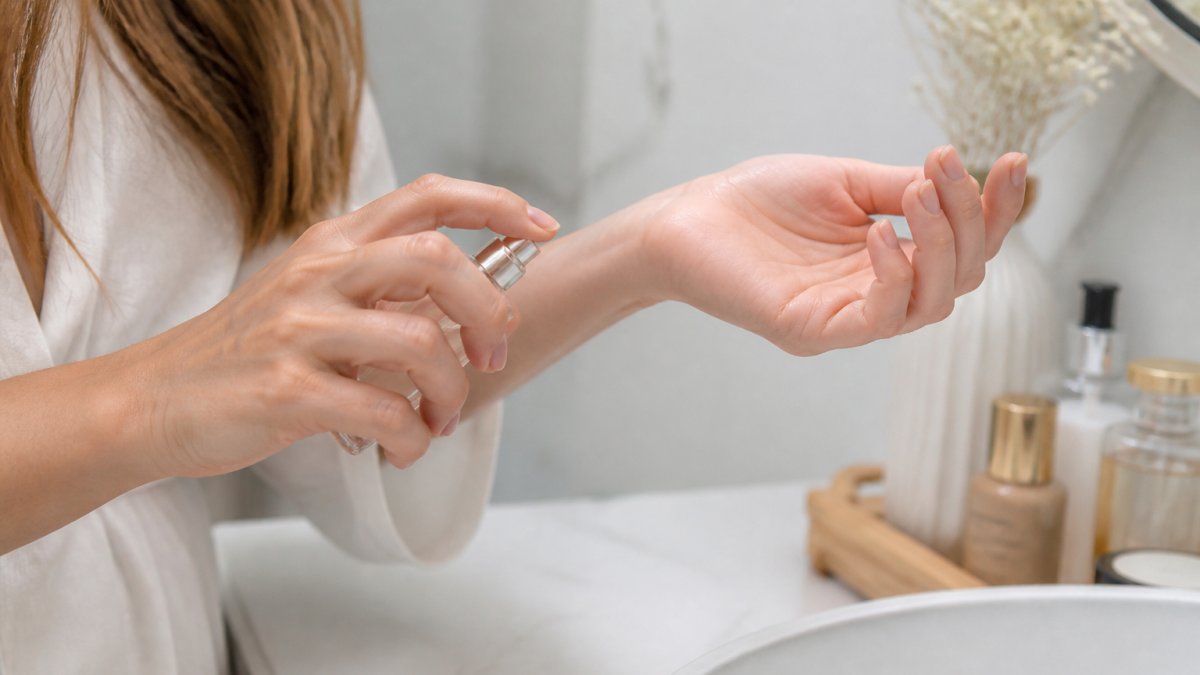
Follow this order:
- Start with clean, moisturized skin. Apply an unscented lotion or a thin layer of petroleum jelly to the application area. This creates a buffer between your skin and the fragrance.
- Choose your spot. Inner wrists, behind the ears, and the inner elbows work well. Skip the neck and chest if your skin there is sensitive.
- Dab, do not rub. Press the bottle or a fingertip to the spot and hold for a second. Rubbing creates heat and friction, which can trigger irritation.
- Let it dry completely. Give it 30 seconds before adding clothing or touching the area.
- Apply to clothing as a backup. Spray a light mist on a scarf, collar, or inside hem for extra staying power without extra skin contact.
- Reapply sparingly. One touch-up midday is plenty. More layers mean more exposure.
For hair, spray onto a brush first, then run it through. Direct spraying on the scalp can irritate skin and dry out strands.
What to Do If a Reaction Occurs
Most guides stop at "patch test first" and never tell you what to do when a reaction shows up hours after application, the part of sensitive-skin fragrance care that matters most.
Step 1: Stop the Exposure Immediately
Act fast. The longer fragrance sits on your skin, the more it can drive an irritant or allergic response.
- Wash the area. Use lukewarm water and a gentle, unscented cleanser. Hot water can worsen redness.
- Skip the scrub. Do not exfoliate, rub, or use a washcloth. Friction damages the barrier further.
- Remove treated clothing. If you sprayed a shirt, take it off and wash it separately before wearing it again.
Step 2: Calm the Skin
- Apply a cool compress. A clean, damp cloth helps reduce redness and itching.
- Use an unscented moisturizer. Plain petroleum jelly or a fragrance-free cream supports the skin barrier while it recovers.
- Avoid other fragranced products. That includes lotions, detergents, hair products, and even scented hand soap.
Step 3: Track the Timeline
Write down when the reaction started, how long it lasted, and what it looked like. This log helps a dermatologist distinguish irritant from allergic contact dermatitis.
A common pattern:
- Reaction within minutes to a few hours, more likely irritation.
- Reaction 12 to 48 hours later, more likely allergy.
- Reaction that spreads beyond the application site, strongly suggests allergy.
Step 4: Know When to Seek Medical Advice
Most mild irritation clears within days once the product is removed. Seek medical advice if:
- The reaction spreads, blisters, oozes, or becomes painful.
- It affects your face, eyelids, or a large area of skin.
- It does not improve within a week.
Step 5: Decide What to Do With the Bottle
- If it was irritation: the scent may still be usable in a lower-exposure format, a clothing spray, a hair mist, or a diluted roll-on, after your skin has fully recovered.
- If it was allergy: stop using that scent entirely. Repeated exposure to an allergen can make future reactions worse, and cross-reactivity with similar molecules is common.
- If you are unsure: treat it as an allergy until a clinician says otherwise. The cost of avoiding a scent is low; the cost of sensitizing yourself further is not.
Building a Personalized Application Plan That Lasts
A repeatable plan beats a one-time fix. Track what works and adjust as your skin changes with seasons, stress, and hormones.
Build your plan around four parts:
- A tested scent list. Keep a running list of scents that passed your patch test.
- A safe application map. Note which body areas tolerate fragrance and which do not.
- A fabric list. Record which clothing items handle a spray without staining.
At Ruth+Bo, our discovery sets are built for exactly this process: sample several story-driven scents without committing to a full bottle, and our thematic gift sets pair scents that layer well together. Every fragrance is IFRA-compliant and made with clean ingredients.
Frequently Asked Questions
Where should you apply perfume if you have sensitive skin?
Stick to pulse points where skin is thicker and less reactive: wrists, inner elbows, and behind the ears. Avoid the neck and chest if those areas have shown reactions before. Apply to clean, moisturized skin and let the perfume dry without rubbing. If you want to reduce skin contact further, spray a small amount on a scarf or collar instead. Always patch test a new scent on your inner forearm for 48 hours before wearing it on pulse points.
Can perfume cause contact dermatitis?
Yes. Fragrance is one of the most common causes of allergic contact dermatitis, according to the American Academy of Dermatology. Symptoms include redness, itching, and small bumps that appear where the perfume was applied. This is different from irritation, which tends to sting or burn immediately and fades once the product is removed. If you develop a rash that spreads or persists, stop using the product and see a dermatologist for patch testing with a fragrance series.
Should I apply perfume to my clothes instead of my skin?
Applying perfume to clothing reduces direct skin contact, which helps if your skin reacts easily. Spray from about 6 to 8 inches away onto a scarf, coat lining, or the inside of a sleeve. Test on a hidden hem first, because some fabrics, especially silk and light-colored synthetics, can stain or discolor. Never spray perfume on sunburned, freshly shaved, or broken skin. For sensitive skin, clothing application is a practical alternative when you still want scent longevity without irritation.
What fragrance ingredients should sensitive skin avoid?
The biggest triggers include linalool, limonene, citronellol, geraniol, and eugenol. Synthetic musks and strong alcohol bases can also irritate. Look for fragrances labeled IFRA-compliant, which means the formula follows International Fragrance Association safety standards. Choose alcohol-light or oil-based formats when possible, and avoid products with long ingredient lists of unlabeled "parfum" if you have known allergies. Patch test any new product regardless of its ingredient claims.
Reactive skin does not have to mean giving up fragrance. It means testing first, applying carefully, and knowing your own limits. Ruth+Bo makes that easier with discovery sets for sampling, clear ingredient lists, and IFRA-compliant blends rooted in story and faith. Explore the collection and find a scent your skin can wear. Add to cart when you are ready.