
How to Layer Fragrances for a Unique Scent
Table of Contents
- Why Layering Fragrances Creates a Scent No One Else Has
- Fragrance Layering Rules for Beginners
- Best Perfume Combinations for Layering
- How to Apply Layered Scents to Pulse Points
- Using Matching Body Lotions and Layering Non-Perfume Products
- How to Make Perfume Last Longer
- Troubleshooting Muddy Scents, Skin Chemistry, and Seasonal Layering
- Building a Signature Scent Through Experimentation
- Frequently Asked Questions
Last Updated: October 6, 2026
Why Layering Fragrances Creates a Scent No One Else Has
Learning how to layer fragrances for a unique scent is the fastest way to stop smelling like everyone else, and once you layer fragrances well, you never go back.
It works because most perfumes are built from a small set of familiar accords. Two people wearing the same popular bottle will smell nearly identical for the first hour.
The trick is knowing the rules before you break them. Below, we break down the exact order, ratios, and pairings that make layering work.
Fragrance Layering Rules for Beginners
Start simple: choose one heavier scent as your base and one lighter scent on top, then apply the heavier one first. That single rule prevents most beginner mistakes. Fragrance layering rules for beginners come down to order, ratio, and restraint.
The 3:1:1 Rule and the 50-30-20 Rule Explained
The 3:1:1 rule is a simple ratio for beginners: three sprays of your base scent, one spray of your middle scent, and one spray of your top scent.
The 50-30-20 rule works on scent families instead of sprays.
Use the 3:1:1 rule when you already know your scents. Use the 50-30-20 rule when you are still choosing which families to combine.
Order of Application: Heavier Notes First
Apply heavier notes first, then lighter ones on top. Heavier base notes like oud, amber, or woods need time to settle into the skin. Lighter top notes like citrus or fresh florals sit on the surface and fade fast.
If you reverse the order, the light notes get buried. The heavy base swallows them, and you lose the brightness you wanted.
- Base first: woods, amber, oud, musk
- Middle next: florals, spices, gourmand notes
- Top last: citrus, herbs, light fruits
Best Perfume Combinations for Layering
The best perfume combinations for layering share at least one note, and that shared note is the bridge. When two fragrances both contain, say, vanilla or cedar, that common molecule appears in both dry-downs, so your nose reads the blend as one continuous scent instead of two separate ones. Pair scents with no overlap and the brain hears two competing signals, that is the clash.
Why Some Notes Bridge and Others Fight
Think in terms of note families and their weight:
- Resins and woods (amber, oud, sandalwood, vetiver): heavy, slow to evaporate, and they anchor a blend. Two heavy bases layered together usually muddle because neither yields.
- Gourmands (vanilla, caramel, tonka): sweet and dense, and they bridge beautifully with amber, musk, and soft woods.
- Florals (rose, jasmine, peony): mid-weight; they sit between a heavy base and a bright top and can go either direction.
- Citrus and aromatics (bergamot, lemon, lavender, mint): light and fast-fading; they lift a heavy base but vanish within an hour or two.
- Musk: the universal bridge. A clean musk rarely clashes and can soften the seam between almost any two families.
A reliable rule: pair across weight, not within it. One heavy base plus one light top almost always works. Two heavy bases or two bright tops usually fight.
Pairings by Fragrance Family
Match families that already speak the same language, and lean on a shared note as the bridge:
- Woody + floral: cedar or sandalwood under a rose or jasmine, the wood grounds the flower.
- Gourmand + amber: vanilla or caramel under a warm resin, both lean sweet and soft.
- Citrus + musk: bright bergamot over a clean musk, the musk catches the citrus as it fades.
- Oud + rose: a classic, opulent pairing that reads rich and deep.
- Fresh aquatic + light floral: clean and airy for daytime.
- Vanilla + smoke or tobacco: sweet meets dry, a modern gourmand pairing.
The Paper-Strip Test Before You Commit
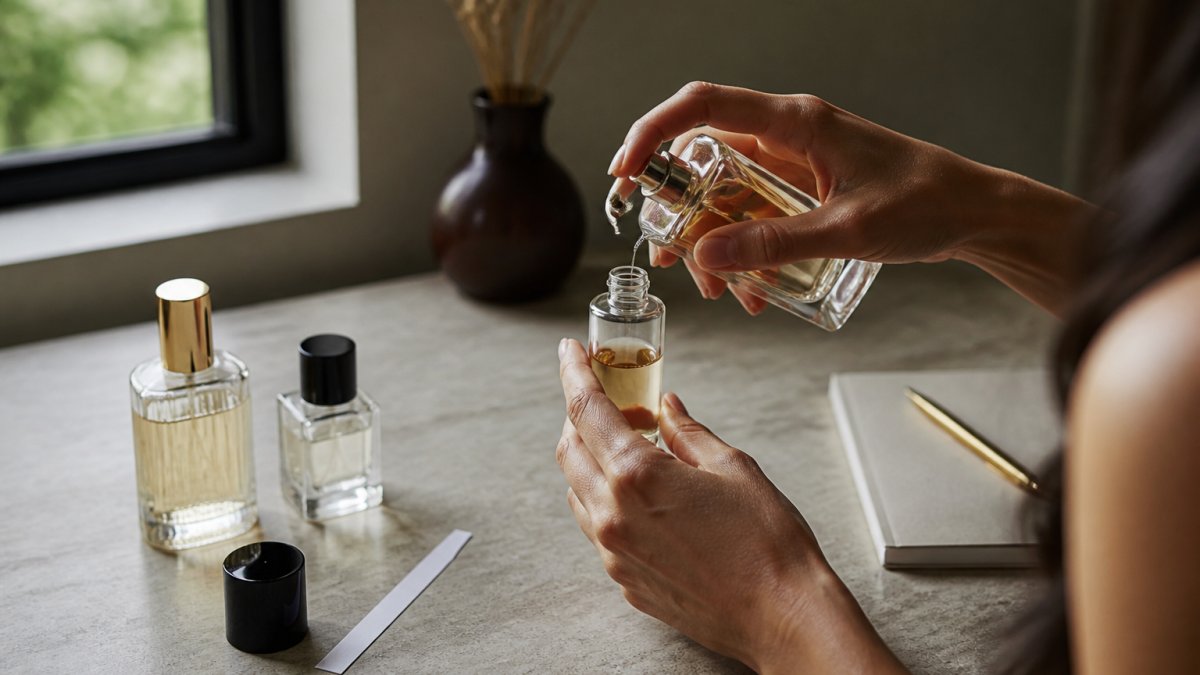
Spray each fragrance on a separate paper strip, label them, wait ten minutes, then hold the strips together and smell the combined cloud. Repeat at the one-hour mark. If the blend still reads harmonious after an hour, it will likely work on skin. If it turns sharp or flat on paper, it will only get worse on skin.
| Base Scent | Top Scent | Shared Bridge Note | Result |
|---|---|---|---|
| Woody | Floral | Cedar or sandalwood | Warm and elegant |
| Gourmand | Amber | Vanilla or tonka | Sweet and rich |
| Citrus | Musk | Clean musk | Clean and bright |
| Oud | Rose | Rose absolute | Deep and opulent |
| Aquatic | Light floral | Soft musk | Airy and fresh |
How to Apply Layered Scents to Pulse Points
Apply your base scent to pulse points first, let it dry, then add the lighter layer on top. Pulse points are the warm spots on your body: wrists, inner elbows, base of the throat, and behind the ears.
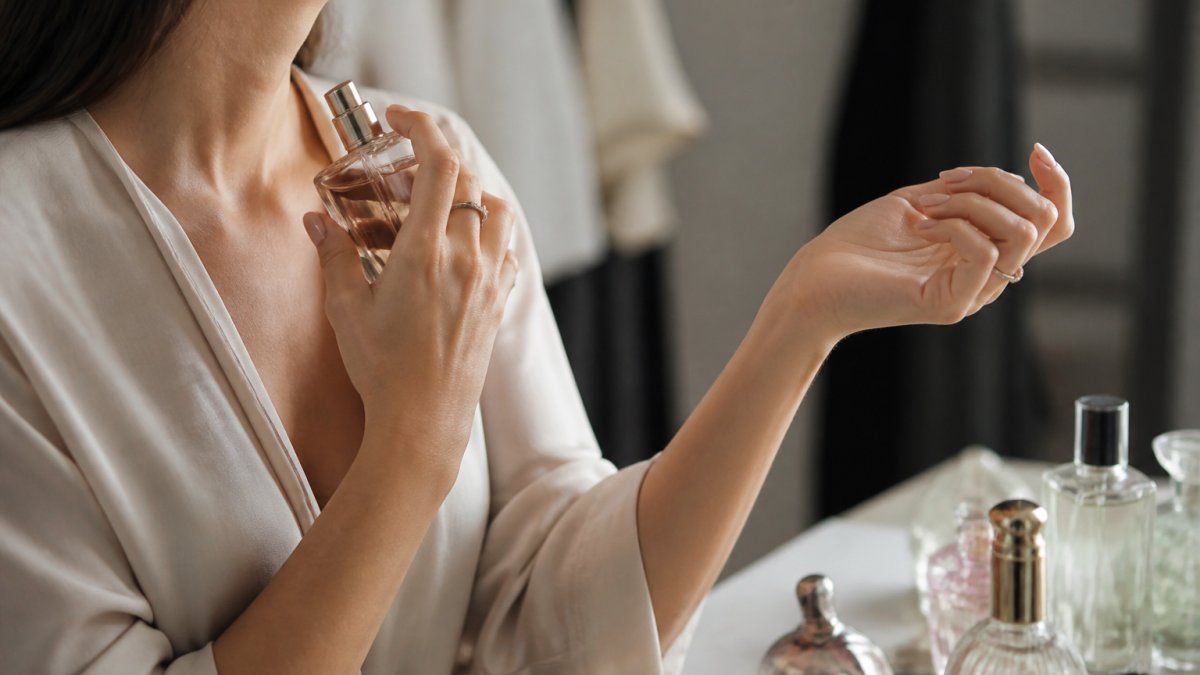
Here is the step-by-step method we recommend:
- Moisturize skin first so scent clings longer
- Spray the heavier base on wrists and throat
- Wait 30 seconds for it to settle
- Mist the lighter scent over the same spots
- Never rub your wrists together, as it crushes the top notes
Using Matching Body Lotions and Layering Non-Perfume Products
Layering is not limited to perfume. Matching body lotion, body wash, and hair mist can all reinforce a scent. A scented body lotion under your fragrance adds a soft base that helps the perfume hold.
Skin hydration matters more than most people realize. Dry skin lets scent fade fast, while moisturized skin holds it. Apply an unscented or matching lotion right after a shower, then add your fragrance while skin is still warm.
- Scented body wash: sets a faint base in the shower
- Matching body lotion: adds a soft, lasting layer
- Hair mist: carries scent without drying strands
- Unscented lotion: boosts longevity without adding a note
How to Make Perfume Last Longer
To make perfume last longer, apply it to moisturized skin and target pulse points, then avoid rubbing. Longevity comes down to three things: skin prep, application technique, and concentration. An eau de parfum holds longer than a lighter concentration because it carries more fragrance oil.
Try these habits:
- Apply right after a shower, while skin is warm
- Layer a matching lotion under your scent
- Spray pulse points, not clothing
- Store bottles away from heat and light
- Refresh with a light mist at midday
Troubleshooting Muddy Scents, Skin Chemistry, and Seasonal Layering
A muddy scent means two fragrances are fighting instead of blending. This is the problem most guides ignore, and it is the one you will actually hit. Here is how to diagnose it and fix it.
Diagnosing a Muddy Blend
Muddy blends share three signatures:
- Flat: no single note stands out; it smells like a generic cloud.
- Confused: you catch one note, then another, but they never resolve into one scent.
- Heavy or cloying: the blend feels thick and headache-inducing within an hour.
The usual cause is two heavy layers with no light note to lift them, or two scents that share no bridge note. A second cause is over-spraying: three or more sprays of a strong eau de parfum will overwhelm any top layer.
How to Fix a Layering Mistake
You cannot remove a fragrance, but you can rebalance it. Work in this order:
- Do not add more of the same. Adding a third heavy scent deepens the mud.
- Add one light, clean note as a bridge. A single spray of citrus, lavender, or clean musk can separate two heavy scents and restore clarity.
- If it is still muddy, dilute with an unscented layer. An unscented lotion or a light alcohol-free body mist spreads the concentration and softens the clash.
- If all else fails, reset. Wash the area with unscented soap, apply unscented lotion, and start over with a lighter base.
Skin Chemistry and pH
Skin chemistry and pH play a real role in how a blend develops. The same fragrance can smell different on two people because skin acidity, natural oils, and body temperature shift how the top notes evaporate and how the base notes bloom.
This is why a pairing that wows on a friend may smell plain on you. Test every blend on your own skin, not on paper alone, and give it a full hour before you judge it.
Seasonal Layering Strategies
Season changes the plan because heat amplifies scent and cold suppresses it. Adjust both the families you choose and the number of sprays:
- Warm months: lean on citrus, aquatic, and light florals. Cut your spray count by about a third, since heat makes everything project harder.
- Cold months: build on amber, woods, oud, and gourmand. Cold air mutes scent, so you can afford a heavier base and an extra spray.
- Transitional weather (winter-to-spring): bridge with musk or soft spice. A musk layer keeps a winter amber from feeling heavy as the weather warms, and a soft spice keeps a spring floral from feeling thin.
A simple winter-to-spring recipe: keep your amber or woody base, swap the heavy gourmand top for a light floral, and add one spray of clean musk in between.
Building a Signature Scent Through Experimentation
A signature scent is the blend you return to again and again, and you build it by testing, not guessing.
Ruth+Bo discovery sets make this easy. You can sample story-driven scents side by side and find the pairings that fit your skin before committing to a full bottle.
The goal is not to copy a trend. It is to build a scent that reflects your own identity, one layer at a time.
Frequently Asked Questions
What is the 3:1:1 rule for perfume?
The 3:1:1 rule is a simple ratio for building a layered scent: three sprays of your base fragrance, one spray of a complementary middle scent, and one spray of a lighter top-note fragrance. It keeps the blend balanced so no single scent dominates. Start with the heaviest fragrance as your base, then add lighter accents. If the result feels strong, reduce the middle or top spray rather than the base.
What fragrances layer well together?
Fragrances from the same family layer most easily, like two gourmands or two woody scents. For contrast, pair a vanilla or amber base with a citrus or floral top note. Oud and rose, vanilla and sandalwood, and bergamot and musk are classic combinations. Test on skin, not paper, because body heat changes how each note develops through the dry down.
Is layering 3 perfumes too much?
Three is usually the upper limit before a blend turns muddy. Each fragrance adds notes, and too many competing accords overwhelm the nose. If you want to try three, keep two of them in the same fragrance family and use the third as a light accent. Give the blend 20 to 30 minutes to settle before deciding whether it works.
How do you layer perfume without it smelling overwhelming?
Apply less of each fragrance than you would alone, and spray from farther away. Start with one spray of your base, wait a minute, then add a single spray of the second scent. Focus on pulse points and avoid spraying clothing, which holds scent longer than skin. If the projection feels heavy, step outside for fresh air and reassess after 15 minutes.
Finding a blend that feels like yours takes patience, and the right scents make the process far easier. Ruth+Bo offers modern fragrances rooted in story and faith, with discovery sets for sampling and thematic gift sets for pairing. Explore our curated collections, test a few combinations, and let your skin do the rest. Get started with Ruth+Bo and build a signature scent that is unmistakably your own.