
Natural Perfume Ingredients Explained Simply
Table of Contents
- What Are Natural Perfume Ingredients?
- Natural vs Synthetic Fragrance: Key Differences
- Where Natural Perfume Ingredients Come From
- Common Natural Fragrance Ingredients by Category
- How to Read Perfume Ingredient Labels
- Perfume Allergen Labeling Requirements in the US
- Safety, Sensitivity, and Skin Considerations
- Why Natural Ingredients Matter for Your Fragrance Choice
Last Updated: August 8, 2026
What Are Natural Perfume Ingredients?
Natural perfume ingredients are aromatic compounds derived from plants, resins, and botanical sources rather than synthesized in a laboratory. At Ruth+Bo, we believe understanding these ingredients transforms how you experience fragrance, moving beyond simply enjoying a scent to appreciating the story behind it.
The term encompasses essential oils, absolutes, resins, and botanical extracts that capture the aromatic profile of their source materials. Natural ingredients contain complex molecular structures with hundreds of individual compounds working together. A natural jasmine absolute contains over 200 aromatic compounds; a synthetic jasmine molecule contains one. This complexity is why natural fragrances often feel more sophisticated and layered.
Natural vs Synthetic Fragrance: Key Differences
Natural fragrance relies on ingredients extracted directly from botanical sources, while synthetic fragrance uses laboratory-created aromatic compounds designed to replicate or enhance natural scents. Neither is inherently superior; the choice depends on your priorities regarding safety, sustainability, performance, and personal values.
Molecular composition. Natural ingredients contain the full spectrum of compounds present in the source material. A drop of rose essential oil contains hundreds of molecules working in concert. Synthetic fragrances typically feature specific target molecules like linalool for floral notes or limonene for citrus brightness. This explains why natural fragrances often smell more "alive" and evolving, while synthetics tend toward consistency and precision.
Longevity and sillage. Sillage refers to how far a fragrance projects and how long it lingers. Natural ingredients, being more volatile, often fade faster than synthetics. If you need a fragrance lasting eight hours with strong projection, synthetics typically deliver better performance. Natural fragrances often require reapplication but reward you with evolution and intimacy.
Skin reactivity. Natural ingredients carry inherent allergen potential because they contain multiple compounds, some of which may trigger sensitivity in certain individuals. Synthetic molecules are more predictable, presenting a single sensitization risk. Neither category is universally safer; safety is individual.
Regulatory transparency. In the United States, fragrance ingredients are largely protected as trade secrets. Manufacturers can list "fragrance" or "parfum" without disclosing individual components. Natural ingredient advocates argue this opacity makes synthetic fragrance ingredients harder to evaluate for safety; synthetic advocates note that natural ingredients also hide behind this same legal protection.
Cost and availability. Natural ingredients fluctuate in price based on harvest and climate. Sandalwood prices have tripled in a decade due to overharvesting. Synthetic ingredients offer price stability and unlimited supply, reducing pressure on wild plant populations.
Where Natural Perfume Ingredients Come From
Natural perfume ingredients originate from botanical extracts harvested from plants, trees, flowers, resins, and other organic sources across the globe. Understanding their origin connects you to the geography and cultivation practices that make your fragrance possible.
Botanical extracts and essential oils
Essential oils are concentrated aromatic liquids extracted from plant material. A single pound of rose essential oil requires approximately 60 pounds of rose petals, illustrating both the concentration and resource intensity of natural fragrance production.
Absolutes differ from essential oils in extraction method and composition. An absolute captures additional compounds beyond the most volatile ones, resulting in richer, more complex scent profiles. Jasmine absolute contains compounds that pure jasmine essential oil misses, giving it a fuller, more animalic quality that perfumers prize for depth.
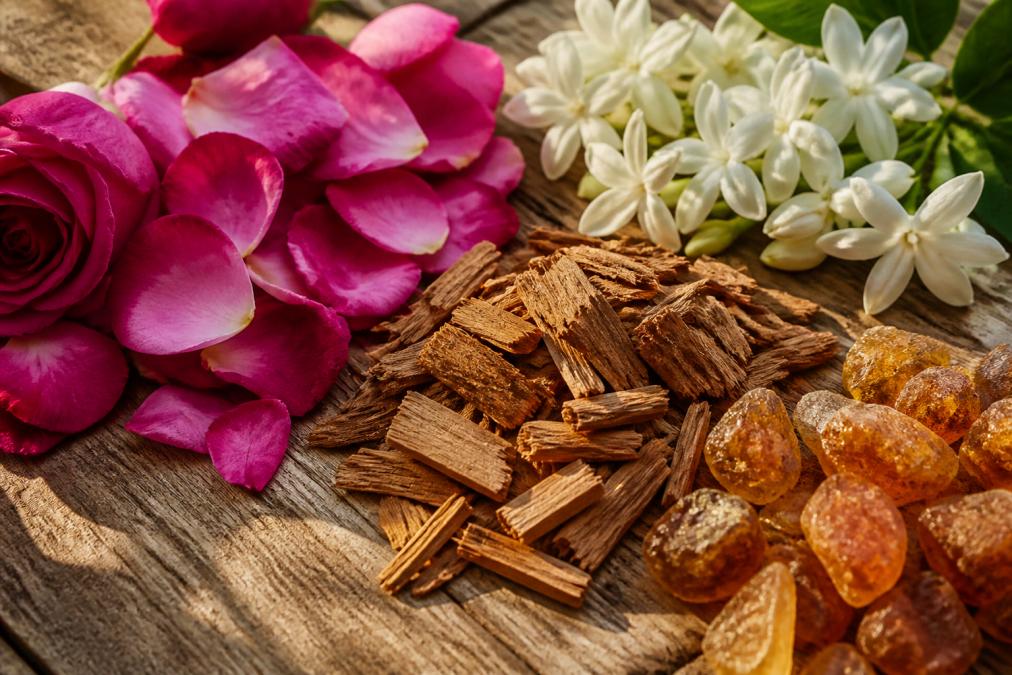
Resins and balsams come from tree secretions: frankincense from Boswellia trees, myrrh from Commiphora trees, benzoin from Styrax trees. These materials provide the base notes that anchor a fragrance, offering warmth, longevity, and grounding presence. Frankincense has been traded for over 5,000 years and appears in biblical narratives, making it meaningful for consumers seeking fragrances rooted in timeless stories.
Terpenes are the organic compounds responsible for most plant aromas. Limonene gives citrus its brightness, linalool provides floral sweetness, and pinene delivers the fresh green quality of evergreen needles. Natural citrus oils smell more complex than synthetic citrus because they contain dozens of terpenes working together, not a single limonene molecule.
Extraction methods: distillation, expression, and solvent extraction
Steam distillation is the oldest and most common extraction method. Steam passes through plant material, vaporizing volatile aromatic compounds. The vapor cools and condenses, separating into essential oil and hydrosol. This method works well for hardy plant material like lavender, eucalyptus, and rosemary but can damage delicate flowers through heat exposure.
Cold pressing or expression mechanically extracts oil from citrus peels without heat. The peel is pressed, rupturing oil glands and releasing the aromatic liquid. Cold-pressed oils preserve heat-sensitive compounds and deliver the bright, fresh character citrus enthusiasts expect.
Solvent extraction uses chemical solvents (traditionally hexane, now often ethanol or CO2) to dissolve aromatic compounds from plant material. This method captures compounds that distillation cannot, the full complexity of delicate flowers like jasmine, tuberose, and gardenia. Solvent extraction produces absolutes rather than essential oils and requires careful solvent removal to ensure safety.
Supercritical CO2 extraction uses pressurized carbon dioxide as a solvent. It offers advantages of solvent extraction without chemical residues, producing clean extracts with excellent aromatic fidelity. The process is expensive and requires specialized equipment, making CO2 extracts premium-priced but increasingly popular among brands prioritizing purity and safety.
The extraction method dramatically affects the final scent. Steam-distilled rose oil smells fresh and slightly herbaceous; solvent-extracted rose absolute smells rich, honeyed, and deeply floral.
Common Natural Fragrance Ingredients by Category
Natural fragrance ingredients organize into categories based on their olfactory character and role in the fragrance pyramid. Top notes provide the first impression, heart notes define the fragrance's personality, and base notes provide longevity and grounding.
Floral notes
Floral ingredients form the heart of most fragrances and represent the largest category of natural materials. Rose, jasmine, tuberose, gardenia, violet, and hyacinth deliver the sweetness and complexity that perfumers layer to create sophisticated scents.
Rose appears in nearly every fragrance tradition. Bulgarian rose oil from the Valley of Roses carries a fresh, slightly herbaceous quality; Turkish rose offers deeper sweetness. Geraniol, the primary component of rose oil, provides the rosy character, but dozens of secondary compounds create the complexity that makes natural rose smell alive and evolving.
Jasmine delivers intoxicating sweetness with an almost animalic undertone. Jasmine sambac from India and Egypt produces absolutes that smell creamy and narcotic; jasmine grandiflorum from Morocco offers lighter, more delicate character. Jasmine is expensive, making it a marker of premium fragrances.
Tuberose provides creamy, almost indolic sweetness. Indole, a naturally occurring compound in tuberose and other flowers, creates sensual, almost animalic depth in fragrance. Many people find tuberose overwhelming in high concentrations; it's a love-it-or-hate-it ingredient.
Violet leaf absolute smells green, slightly metallic, and fresh, quite different from violet flower. Violet leaf provides the green, ozonic quality that perfumers use to add freshness and complexity to floral compositions.
Woody and resinous ingredients
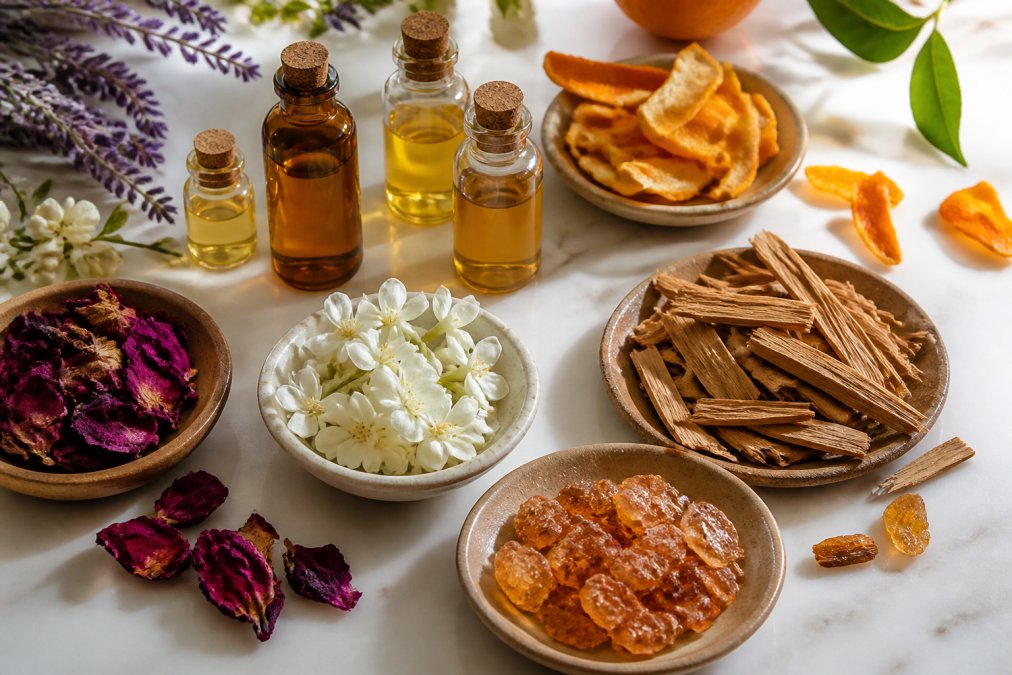
Woody and resinous materials provide the foundation that makes fragrances last. These base notes anchor the composition and create the grounding presence that distinguishes a sophisticated fragrance.
Sandalwood delivers creamy, slightly sweet woodiness. Indian sandalwood from the Mysore region represents the gold standard, warm, buttery, and complex. Sandalwood has faced sustainability challenges due to overharvesting, making ethical sourcing increasingly important.
Cedarwood offers dry, slightly smoky woodiness. Virginia cedarwood smells fresh and pencil-like; atlas cedarwood from Morocco provides warmer, more resinous character. Cedarwood's dryness balances floral sweetness, making it essential for well-rounded compositions.
Vetiver delivers earthy, slightly smoky character with a hint of green freshness. Haitian vetiver represents the most prized source, offering complex earthiness that perfumers layer into masculine fragrances and sophisticated unisex compositions.
Frankincense and myrrh carry historical and spiritual significance. Frankincense offers warm, slightly citrusy incense character; myrrh delivers darker, more resinous warmth. These materials appear in fragrances designed to evoke meaning and narrative.
Oud (also called agarwood) represents one of perfumery's most expensive and controversial materials. Oud develops when certain Aquilaria trees become infected with a specific mold, triggering resin production. The resulting wood smells woody, animalic, and slightly medicinal, intensely complex. Wild oud is now endangered; most commercial oud comes from cultivated trees or is synthesized.
How to Read Perfume Ingredient Labels
Understanding fragrance labels requires knowing how regulations work and what manufacturers are legally required to disclose. In the United States, fragrance ingredients receive special protection under the Fair Packaging and Labeling Act, allowing manufacturers to list "fragrance" or "parfum" as a single ingredient without disclosing individual components.
When evaluating a natural fragrance label, look for these indicators:
Explicit ingredient lists. Brands committed to transparency list individual fragrance components rather than hiding behind the "fragrance" umbrella. Ruth+Bo provides detailed ingredient disclosure, allowing you to identify potential allergens and understand exactly what you're applying to your skin.
Certification marks. Look for IFRA (International Fragrance Association) compliance statements, which indicate the fragrance has been safety-tested and uses ingredients within established safety limits.
Alcohol denat percentage. Most fragrances use alcohol (ethanol) as a carrier to dilute concentrated fragrance oils and enable even application. "Alcohol denat" refers to denatured alcohol. Higher alcohol percentages mean more dilute fragrance; lower percentages indicate higher fragrance concentration.
Allergen declarations. Federal regulations require disclosure of 22 fragrance allergens if they exceed specific concentration thresholds. These include limonene, linalool, geraniol, and eugenol, compounds naturally present in many botanical ingredients. A label listing these allergens doesn't mean the fragrance is unsafe; it means the manufacturer is transparently disclosing compounds that trigger reactions in sensitive individuals.
Source attribution. Premium natural fragrance brands often identify ingredient sources, "Bulgarian rose oil," "Haitian vetiver," "Madagascar vanilla." This level of detail indicates commitment to quality and traceability.
Perfume Allergen Labeling Requirements in the US
The United States requires fragrance manufacturers to disclose 22 specific fragrance allergens on product labels when they exceed concentration thresholds established by the International Fragrance Association. This regulation, enforced by the Federal Trade Commission and the FDA, aims to protect consumers with fragrance sensitivities.
The 22 declared allergens include naturally occurring compounds like limonene (found in citrus oils), linalool (found in lavender and other flowers), geraniol (found in rose oil), and eugenol (found in clove and cinnamon). These compounds trigger reactions in some individuals despite being "natural", a critical point that natural fragrance marketing sometimes obscures.
Labeling requirements specify that allergens must be listed if they exceed 0.001% in leave-on products (like fragrances) or 0.01% in rinse-off products. These thresholds are intentionally low, designed to catch even trace amounts that might trigger sensitive individuals. A fragrance containing Bulgarian rose oil will likely list linalool and geraniol because rose oil naturally contains these compounds above the threshold.
Some brands, including Ruth+Bo, exceed these requirements by providing comprehensive ingredient lists, recognizing that transparency builds trust with consumers who want to make informed choices.
Safety, Sensitivity, and Skin Considerations
Natural fragrance ingredients carry the same potential for triggering sensitivity and allergic reactions as synthetic ingredients. The assumption that "natural equals safe" represents a common misunderstanding that can lead to adverse reactions in sensitive individuals.
Sensitivity develops through repeated exposure to specific compounds. Limonene and linalool, naturally present in many fragrances, are among the most common fragrance allergens reported to regulatory agencies. A person who tolerates a fragrance for months may suddenly develop a reaction; sensitivity builds over time with exposure. Fragrance rotation matters; wearing the same fragrance daily increases sensitization risk.
Contact dermatitis from fragrance appears as redness, itching, or burning on the skin where the fragrance was applied. Photocontact dermatitis, a reaction triggered by sun exposure after fragrance application, can cause pigmentation changes or severe burning. If you experience these reactions, discontinue use immediately and consult a dermatologist.
Some individuals experience fragrance-triggered migraines or respiratory sensitivity through inhalation rather than skin contact. People with asthma or chronic rhinitis should be especially cautious with fragrance exposure.
To minimize sensitivity risk, apply fragrance to pulse points where skin is thinner and circulation is high: wrists, neck, behind ears, inner elbows. Avoid applying fragrance directly to broken skin or areas prone to irritation. If you have known fragrance sensitivities, patch-test new fragrances on a small area of skin before full application.
Why Natural Ingredients Matter for Your Fragrance Choice
Choosing fragrances built on natural ingredients reflects values beyond scent preference. It signals commitment to understanding what touches your skin, supporting sustainable sourcing practices, and connecting with fragrances that carry meaning and narrative.
Natural ingredients offer complexity that engages your senses differently than synthetics. A fragrance built on natural rose, jasmine, and sandalwood evolves throughout the day as different compounds volatilize at different rates. You experience the fresh top notes first, then the floral heart emerges, and finally the woody base provides grounding. This evolution creates an intimate, personal experience.
When you understand that your fragrance contains Bulgarian rose oil harvested from the Valley of Roses, frankincense from Somali trees, and sandalwood from Indian forests, you're wearing a story. Ruth+Bo fragrances are rooted in faith and meaning, designed to evoke timeless narratives and connect your personal identity with something larger than yourself.
Natural ingredients also carry sustainability considerations that matter to conscious consumers. Overharvesting of sandalwood, oud, and other premium materials has created ecological pressure on wild populations. Brands committed to ethical sourcing work with suppliers who practice sustainable cultivation, replanting programs, and fair-trade practices. By choosing fragrances built on responsibly sourced natural ingredients, you support these practices and encourage broader industry adoption.
Understanding natural perfume ingredients transforms fragrance from a simple accessory into a meaningful choice. When you recognize the botanical sources, extraction methods, and aromatic compounds in your fragrance, you appreciate the sophistication and intention behind it. Ruth+Bo offers curated collections of natural fragrances rooted in story and faith, allowing you to explore complex, long-lasting scents that connect your personal identity with timeless narratives. Discover your signature fragrance through our discovery sets and experience how natural ingredients create depth and meaning that synthetic fragrances cannot replicate.
Frequently Asked Questions
What are natural perfume ingredients, and are they really different from synthetic ones?
Natural perfume ingredients come from botanical sources, flowers, woods, resins, and citrus fruits, extracted through distillation, cold pressing, or solvent extraction. Synthetic fragrances are created in laboratories to replicate or enhance natural scents. Natural ingredients offer complexity and evolution on the skin, while synthetics provide consistency and longevity. Both can be safe and effective; the choice depends on your preference for olfactory profile, sustainability values, and skin sensitivity.
How do I identify natural ingredients when reading a perfume label?
Look for terms like 'essential oils,' 'botanical extracts,' 'absolutes,' and 'natural fragrance compounds' in the ingredient list. The Fragrance Ingredient Disclosure Statement (required on US labels) lists fragrance components. Brands committed to transparency often specify botanical sources, rose absolute, sandalwood oil, bergamot, rather than generic 'fragrance' listings. Check for IFRA compliance certifications, which indicate adherence to safety standards for natural ingredients.
What perfume allergens must be labeled under US regulations?
The FDA and IFRA (International Fragrance Association) require disclosure of 26 fragrance allergens known to cause sensitization in some individuals. These include linalool, limonene, geraniol, and cinnamyl alcohol, among others. US law requires these allergens to be listed on product labels or in ingredient disclosures. If you have sensitive skin or known fragrance allergies, review these listed allergens before purchase. Ruth+Bo provides detailed ingredient transparency so you can make informed choices.
Do natural perfumes last as long as synthetic fragrances?
Natural perfumes typically have shorter longevity than synthetics because botanical extracts contain volatile organic compounds that evaporate more quickly. However, natural base notes, resins, woods, and absolutes, provide lasting power. The fragrance pyramid (top, heart, and base notes) determines longevity regardless of source. High-quality natural perfumes with strong base notes can last 4-6 hours or longer, while synthetics may last 8+ hours. Layering and application technique also affect staying power.
This article was written using GrandRanker