

How to Choose Long Lasting Perfume: A 2026 Guide
Table of Contents
- Why Some Perfumes Fade in Hours (And Others Last All Day)
- Perfume Concentration Guide: Parfum, Eau de Parfum, and Eau de Toilette
- The Best Base Notes for Longevity: Resins, Woods, and Fixatives
- How Skin Chemistry, Diet, and Lifestyle Change Staying Power
- Climate, Humidity, and Storage: Environmental Factors That Break Down Scent
- How to Make Perfume Last Longer on Skin: Application and Layering Steps
- How to Test a Perfume's Longevity Before You Commit
- Conclusion
- Frequently Asked Questions
Last Updated: October 3, 2026
Why Some Perfumes Fade in Hours (And Others Last All Day)
The answer comes down to three variables working together: fragrance concentration, the molecular weight of the ingredients, and how your skin holds onto scent. A perfume that disappears by lunch usually lacks heavy base notes or fixatives, the ingredients that anchor lighter molecules and slow their evaporation.
Most shoppers blame their skin when a scent fades. That's only part of the story. The International Fragrance Association standards on ingredient safety govern what goes into a formula, but they don't dictate how long it lingers.
Below, we'll show you how to read a fragrance pyramid, which base notes hold longest, and the application steps that add hours to wear time. A common mistake is spraying more to make a scent last.
Perfume Concentration Guide: Parfum, Eau de Parfum, and Eau de Toilette
Concentration is the single biggest predictor of how long a perfume lasts. The more fragrance oil in the formula, the slower it evaporates, and the longer it stays on skin.
The main categories, from strongest to lightest:
- Parfum extract: Highest oil concentration, typically the longest wear, often 6-8 hours or more
- Eau de parfum (EDP): A balanced middle ground, usually 4-6 hours
- Eau de toilette (EDT): Lighter, often 2-4 hours
A fragrance concentration is the ratio of aromatic oil to alcohol and water in a bottle. Higher concentration means slower evaporation rate and stronger sillage.
What the 3:1:1 Rule Means for Longevity
A simple way to remember the relationship: if you think of a parfum as 3 parts oil, an eau de parfum as roughly 2 parts, and an eau de toilette as 1 part, you get the general hierarchy of staying power. The exact ratios vary by house, but the principle holds. More oil, longer wear.
The Best Base Notes for Longevity: Resins, Woods, and Fixatives
The best base notes for longevity are heavy molecules like resins, woods, and musks, because they evaporate slowly and hold the lighter top notes in place. Look for these on a fragrance pyramid:
- Woody notes: sandalwood, oud, vetiver, patchouli
- Resins and balsams: amber, myrrh, benzoin
- Warm sweet notes: vanilla, tonka bean
A fixative is an ingredient that slows the evaporation of lighter molecules, binding a composition together so it doesn't collapse after the top notes vanish. Natural fixatives include resins and animal-derived musks, while synthetic molecules like certain ambroxan-type compounds offer consistency and, in many cases, better performance.
This is where most people go wrong: they chase a beautiful top note and ignore the base. Top notes are designed to fade. The base is what you live with all day.
How Skin Chemistry, Diet, and Lifestyle Change Staying Power
Skin chemistry is the reason the same bottle can last eight hours on one person and two on another. Four variables do most of the work: sebum (your skin's natural oil), surface pH, hydration level, and body temperature. None of them are fixed, which is why a perfume that faded on you last winter may perform differently in July.
Sebum and Skin Type
Sebum acts as a solvent and a slow-release reservoir for fragrance molecules. Oily skin generally holds scent longer because the lipid layer traps heavier molecules near the surface. Dry skin does the opposite: it absorbs the alcohol carrier quickly and lets the aromatic compounds evaporate with it. If your skin is dry, you are not imagining that everything fades on you.
Surface pH
Skin pH typically sits between 4.5 and 5.5. Formulas built around certain musks and vanillin derivatives read differently on more acidic or more alkaline skin. This is one reason a scent can smell 'sharper' or 'flatter' on you than on a friend, and why the dry down can seem to disappear faster even when the top notes bloom loudly.
Hydration and Transepidermal Water Loss
Hydrated skin has a stronger barrier, which slows transepidermal water loss and keeps the fragrance film intact longer. A fragrance applied to compromised, flaky skin can be gone inside an hour. This is the single easiest variable to control: an unscented moisturizer or a thin layer of petrolatum on pulse points before spraying can add meaningful wear time.
Diet, Medication, and Lifestyle
This is the angle most guides skip, and it is worth understanding because it explains why a signature scent can 'change' on you over months.
- Diet: Diets high in alliums (garlic, onion), cruciferous vegetables, and certain spices can shift the composition of sweat and sebum. The effect is subtle but real, and it is one reason enthusiasts report a fragrance wearing differently after a major dietary change.
- Alcohol: Alcohol is a vasodilator (pubmed.ncbi.nlm.nih.gov). It raises skin temperature and increases perspiration, both of which accelerate evaporation. A scent applied before a night of drinking often reads weaker by hour three.
- Caffeine and stress: Both raise cortisol and body temperature, which can push projection up briefly and then shorten the tail of the dry down.
What You Can Actually Change
The controllable levers are hydration, exfoliation (removing dead cells that trap and dull scent), and avoiding application to freshly shaved or irritated skin. The uncontrollable ones, diet, medication, hormones, and genetics, are useful context rather than fixes. Knowing which is which stops you from buying a fourth bottle of the same perfume hoping it will finally last.
Climate, Humidity, and Storage: Environmental Factors That Break Down Scent
Heat and humidity speed up evaporation, while cold, dry air can make a scent sit closer to the skin. Climate changes how a perfume performs, and there's no single fix that works everywhere.
Storage matters just as much. Fragrance degradation happens when a bottle is exposed to light, heat, or air. Oxidation, the reaction of the formula with oxygen, dulls the scent over time.
| Factor | Effect on Scent | What to Do |
|---|---|---|
| High heat | Faster evaporation | Store below room temperature |
| Direct sunlight | Breaks down molecules | Keep in a dark cabinet |
| Humidity | Alters projection | Store sealed and dry |
| Air exposure | Causes oxidation | Cap tightly after use |
How to Make Perfume Last Longer on Skin: Application and Layering Steps
Learning how to make perfume last longer on skin comes down to preparation and placement. Moisturize first, spray on pulse points, and never rub.
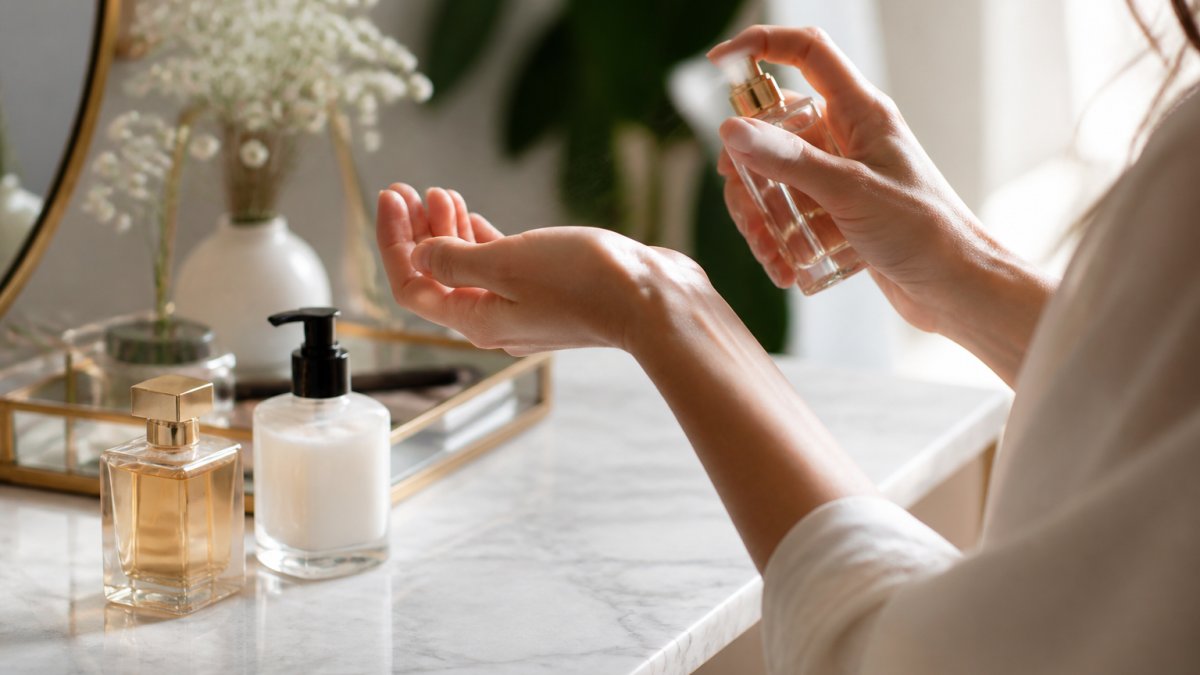
Follow these steps:
- Apply an unscented moisturizer to pulse points and let it absorb.
- Spray perfume onto the wrists, neck, and behind the ears.
- Let it air-dry. Rubbing breaks the molecules and shortens wear.
- Layer with a matching body lotion or a complementary base-note scent.
- Reapply to the base of the neck, not over the original spray, if you need a refresh.
Pulse points work because body heat gently diffuses scent throughout the day. Layering a woody or amber base under a lighter fragrance gives it something to cling to.
How to Test a Perfume's Longevity Before You Commit
Most people decide on a bottle in under ten minutes at a counter. That is not enough time for a fragrance to reach its base notes, which is where longevity actually lives. A proper test takes a full day, and it is the only reliable way to know whether a scent will still be on your skin at dinner.
The One-Day Protocol
- Test on skin, never paper. Paper strips show you the composition, not the performance. Paper has no sebum, no pH, and no body heat, so it will always read longer and flatter than your skin will.
- Spray one fragrance per arm, maximum two per visit. More than that and you get olfactory fatigue, the nose-blindness that makes you think a scent has faded when it is still projecting.
- Note the time of the first spray. Write it down. Memory is unreliable after three hours.
- Check at 1 hour, 3 hours, and 6 hours. At each checkpoint, ask two separate questions: can I still smell it on my skin up close, and can someone standing two feet away smell it? Those are different measurements (longevity vs. sillage) and they fail independently.
- Do not reapply. Reapplying resets the clock and tells you nothing about the original spray.
- Wear it through your normal day. A fragrance that survives a commute, a workday, and a meal is a different product than one tested on a quiet afternoon at home.
What to Record
Keep a simple note for each test: fragrance name, concentration, spray time, hour-one read, hour-three read, hour-six read, and whether the dry down still resembled the opening. After three or four tests you will start to see a pattern in which note families and concentrations actually last on you, and that pattern is more useful than any review.
Sampling Before You Buy
Discovery sets and travel sprays exist precisely for this. A 2 mL spray gives you two or three full-day tests for a fraction of a full bottle, and it lets you evaluate a fragrance across different weather and different weeks of your cycle. If a house does not offer samples, ask at the counter; many will decant a small amount if you are considering a purchase.
Red Flags at the Counter
- The sales associate sprays it on a card and tells you it lasts 'all day.' Cards do not predict skin performance.
- You are asked to decide within the first fifteen minutes. That is the top-note window, and top notes are designed to fade.
- The tester bottle has been sitting in direct light or near a window. A degraded tester will underperform the sealed bottle you actually buy.
Conclusion
Choosing a long lasting perfume takes more than a quick sniff at the counter. It takes reading concentration, recognizing anchor notes, and testing on your own skin. At Ruth+Bo, our discovery sets let you sample before you commit. Explore our curated feminine and masculine scents and find the one that stays with you.
Frequently Asked Questions
What type of perfume lasts the longest?
Parfum extract and eau de parfum generally last longest because they contain higher concentrations of fragrance oils. Parfum extract can stay on skin for 8 hours or more, while eau de parfum typically lasts 4 to 6 hours. Eau de toilette fades faster, often within 2 to 4 hours. Base notes like oud, sandalwood, and amber also extend wear time, so check the fragrance pyramid before buying.
Does skin type affect how long perfume lasts?
Yes. Dry skin absorbs fragrance oils quickly, which shortens longevity. Oily skin holds scent molecules longer because oils slow evaporation. Drinking plenty of water and applying an unscented moisturizer before spraying can help dry skin retain a long lasting perfume. Humidity in the air also plays a role, so you may need to reapply more often in dry climates.
How can I tell if a perfume will last before buying it?
Spray a small amount on your wrist and wait at least four hours. Check how the scent evolves through its top notes, heart notes, and base notes. If the base notes are still noticeable after four hours, the perfume has good longevity. Also look for fixatives like amber, musk, or vetiver in the ingredient list. Discovery sets let you test several scents on your own skin without committing to a full bottle.
Does the price of a perfume determine how long it lasts?
No. Price reflects brand, packaging, and marketing as much as ingredients. A lower-priced eau de parfum with strong base notes can outlast an expensive eau de toilette. Focus on concentration, fixatives, and how the scent performs on your skin chemistry. Testing a perfume on your own skin is the only reliable way to judge its staying power.
Finding a fragrance that lasts isn't about spraying more. It's about choosing a scent with the right concentration, base notes, and staying power for your skin. Ruth+Bo offers story-driven fragrances with curated discovery sets and thematic gift sets, so you can test before you commit and give a scent that means something. Get started with Ruth+Bo and find a fragrance that lasts from morning to night.
%0A%0APerfume%20Concentration%20Guide:%20Parfum,%20Eau%20de%20Parfum,%20and%20Eau%20de%20ToiletteWhat%20the%203:1:1%20Rule%20Means%20for%20Longevity%0A%0AThe%20Bes...)