

How to Make Perfume Smell Stronger: 7 Proven Methods
Table of Contents
- Why Your Perfume Fades (and What Actually Controls Longevity)
- The Best Pulse Points for Perfume (and How to Apply Correctly)
- Fragrance Layering Techniques That Amplify Scent Without Clashing
- How to Store Perfume to Maintain Potency and Prevent Degradation
- Environmental Factors That Weaken Your Perfume (and How to Counter Them)
- Reapplication Strategies: When and How to Refresh Your Scent
- Common Mistakes That Make Perfume Smell Weaker
- Conclusion: Building a Fragrance Routine That Lasts
- Frequently Asked Questions
Last Updated: September 25, 2026
Why Your Perfume Fades (and What Actually Controls Longevity)
If your perfume disappears by lunch, the problem is usually not the scent itself. It is how you apply it, where you store it, and how your skin holds fragrance molecules. This guide from Ruth+Bo breaks down seven proven ways to make perfume smell stronger, from pulse point placement to DIY fixatives.
Fragrance longevity depends on three things: concentration, skin condition, and environment. Get all three right and a single spray can last through a workday.
Here is the core tension most guides ignore. A costly extrait can fade fast on dry skin, while a modest eau de parfum can last hours on well-moisturized skin. The bottle matters less than the canvas.
Fragrance Concentration: Eau de Parfum vs. Pure Parfum vs. Extrait
Fragrance concentration is the amount of perfume oil dissolved in alcohol. It decides how long a scent lasts and how far it projects.
| Type | Oil Content | Typical Longevity | Best For |
|---|---|---|---|
| Eau de toilette | Lower | A few hours | Daytime, light wear |
| Eau de parfum | Medium | Most of a day | Everyday wear |
| Pure parfum | High | Long wear | Evening, special events |
| Extrait | Highest | Longest wear | Statement moments |
Higher oil content means slower evaporation and stronger sillage, the trail a scent leaves behind. If you want a fragrance to smell stronger, start by choosing a higher concentration.
How Skin pH and Hydration Affect Scent Projection
Skin pH is the acid level of your skin, and it changes how fragrance molecules unfold. Dry or acidic skin can pull a scent apart fast. Hydrated skin holds it longer.
This is the chemistry most guides skip. Fragrance molecules bind to moisture and oils on your skin. When skin is dry, those molecules evaporate quickly and the scent fades.
The Best Pulse Points for Perfume (and How to Apply Correctly)
The best pulse points for perfume are the inner wrists, the base of the throat, behind the ears, the inner elbows, and behind the knees. These spots radiate body heat, which lifts scent into the air all day.
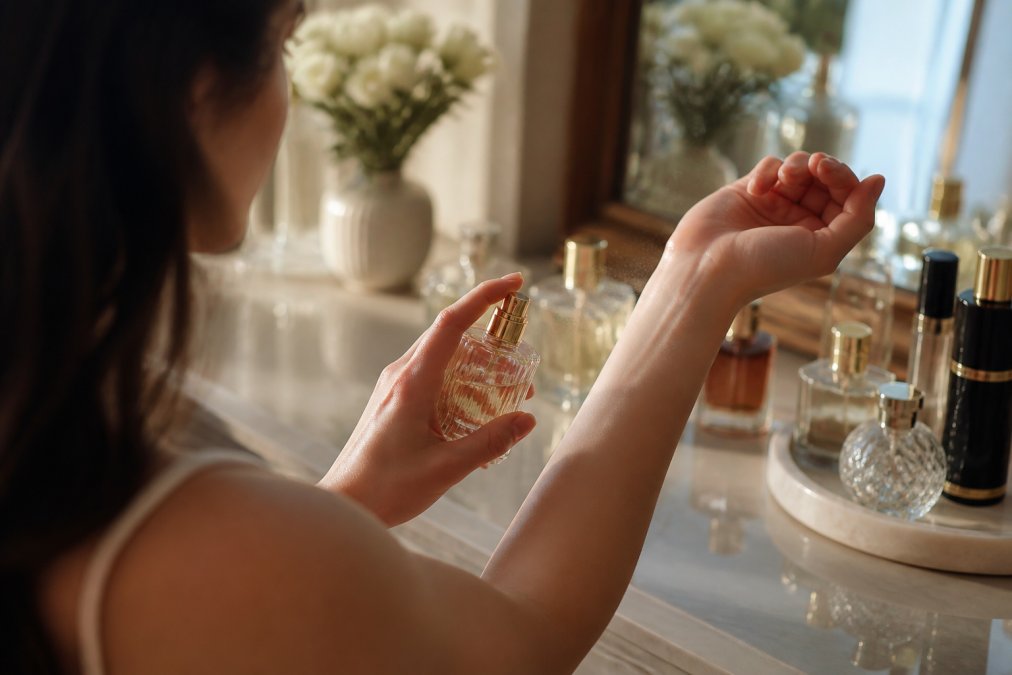
Apply to clean, moisturized skin. Hold the bottle a few inches away and spray once per point. Do not spray and walk through a mist; that wastes most of the product.
- Inner wrists: classic spot, easy to refresh
- Base of throat: strong projection near the face
- Behind the ears: subtle, personal scent bubble
- Inner elbows: good for warmer days
- Behind the knees: scent rises as you move
Why You Should Never Rub Your Wrists Together
Rubbing your wrists together breaks the fragrance. The friction creates heat, which speeds evaporation rate and crushes the top notes before they can develop.
Let each spray dry on its own. The scent will move through its fragrance pyramid the way the perfumer intended, from bright top notes to warm base notes.
Fragrance Layering Techniques That Amplify Scent Without Clashing
Fragrance layering techniques combine two or more scents so they amplify each other instead of fighting. The rule is simple: match families, not opposites.
Start with a scented body lotion in the same family as your perfume. Then spray the fragrance on top.
Try these pairings:
- Warm vanilla lotion under an amber or woody perfume
- Light citrus lotion under a fresh, green scent
- Unscented lotion under anything bold or complex
Using Unscented Moisturizer and Petroleum Jelly as DIY Fixatives
Fixatives are ingredients that slow evaporation and hold scent to the skin. You do not need to buy a specialty product. Plain petroleum jelly and unscented lotion work as DIY fixatives.
How to Store Perfume to Maintain Potency and Prevent Degradation
Knowing how to store perfume to maintain potency is the difference between a scent that lasts years and one that turns in months. Heat, light, and air are the enemies.
- Store upright to prevent leaks and air exposure
- Keep the cap tight between uses
- Avoid direct sunlight and radiators
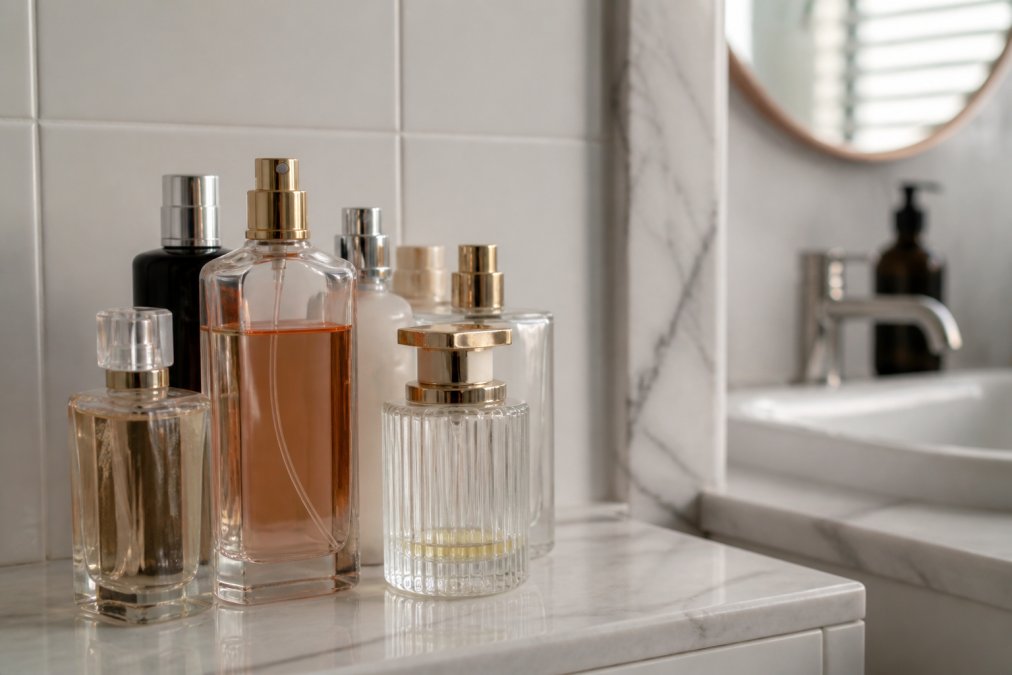
- Skip the bathroom shelf; try a closet or drawer
Environmental Factors That Weaken Your Perfume (and How to Counter Them)
Fragrance leaves your skin through evaporation, and evaporation is driven by three environmental variables: temperature, humidity, and airflow. Change any one and you change how fast a scent disappears.
Temperature
Warm skin releases fragrance molecules faster. That sounds like a good thing, and it is, up to a point. Above roughly 85°F, the top notes can flash off in under 15 minutes, and the heart notes follow quickly. The result is a scent that projects hard for an hour and then vanishes.
Humidity
Humidity is the variable most guides get backwards. High humidity slows evaporation because the air is already saturated with water vapor, so fragrance molecules have less room to escape into. That means scent lingers longer in humid air, but it also means it can feel heavier and closer to the skin, with less sillage.
Airflow and Wind
Moving air strips scent from your skin mechanically. A breezy day can cut wear time by half, because the boundary layer of air around your skin, the thin cushion where fragrance molecules accumulate, is constantly being replaced.
Seasonal Adjustments That Actually Work
- Summer: lighter concentration, more frequent reapplication, base-note-heavy scents, store the bottle in a cool dark place, heat degrades the juice inside the bottle too.
- Winter: richer concentration, heavier application, hydrate aggressively because indoor heating dries skin out.
- Transitional seasons: keep two concentrations of the same scent family on hand and switch based on the day's humidity, not the calendar.
Reading Your Environment Before You Spray
A quick mental check before you apply:
- Is the air dry or humid? Dry means hydrate more and expect faster fade. Humid means spray less and expect a closer scent bubble.
- Is it windy? Add a fabric application point.
- Is it hot? Go lighter, reapply sooner, favor base-heavy scents.
- Are you indoors with heating or AC? Both strip moisture from skin. Prep accordingly.
Match your application to the day, not to a fixed routine, and a single bottle will perform noticeably better across the year.
Reapplication Strategies: When and How to Refresh Your Scent
Reapply every four to six hours, or when you notice the scent has faded to a skin-close whisper. Do not wait until it is completely gone.
- Blot oil from your skin first, so the new spray can settle
- Spray one wrist, then press it to the other
- Add a light mist to hair or clothing for a longer trail
Common Mistakes That Make Perfume Smell Weaker
The biggest mistake is applying to dry skin. Fragrance needs moisture to hold, so dry skin lets it evaporate fast.
Other common errors:
- Rubbing wrists together after spraying
- Storing bottles in a steamy bathroom
- Spraying from too far away, which wastes product
- Over-spraying to compensate for fading, which overwhelms the nose
- Using scented lotion that clashes with the perfume
Conclusion: Building a Fragrance Routine That Lasts
A fragrance that fades by noon is a routine problem, not a product problem. Fix your skin prep, application, and storage, and most scents will hold far longer.
Frequently Asked Questions
Does applying Vaseline make perfume last longer?
Yes. Petroleum jelly creates a barrier that slows evaporation and gives fragrance molecules something to cling to. Apply a thin layer to pulse points before spraying. For a lighter option, use an unscented moisturizer or lotion. Hydrated skin holds scent longer than dry skin because oils trap fragrance molecules and release them gradually throughout the day.
Why does my perfume smell go away so quickly?
Several factors shorten longevity: dry skin, high alcohol content in eau de toilette formulas, rubbing wrists together after spraying, and storing bottles in warm or bright places. Olfactory fatigue also plays a role. Your nose stops registering a scent after prolonged exposure, even though others can still smell it. Try spraying on moisturized skin and storing bottles away from heat and light.
What are the best pulse points for applying fragrance?
The inner wrists, base of the throat, behind the ears, inside elbows, and behind the knees are the best pulse points for perfume. These areas emit body heat, which warms the fragrance and pushes scent molecules into the air. Apply to two or three points maximum. Spraying too many areas overwhelms the nose and causes olfactory fatigue faster.
Does putting perfume in the fridge make it smell stronger?
No. Cold temperatures do not boost scent intensity. Refrigeration can slow evaporation during storage, but it will not make a weak formula stronger when you wear it. In fact, repeated temperature changes from moving a bottle in and out of the fridge can degrade the fragrance over time. Store bottles in a cool, dark cabinet instead.
The real challenge is not finding a stronger scent. It is building a routine that lets a good scent perform the way it should. Ruth+Bo offers refined, faith-rooted fragrances designed to evolve on the skin, plus discovery sets for testing before you commit and thematic gift sets for thoughtful gifting. Get started with Ruth+Bo and find a fragrance that lasts from morning to night.
%0AFragrance%20Concentration:%20Eau%20de%20Parfum%20vs.%20Pure%20Parfum%20vs.%20Extrait%0AHow%20Skin%20pH%20and%20Hydration%20Affect%20Scent%20Projectio...)