
The History of Biblical Fragrances Explained
Table of Contents
- The Role of Perfume in Ancient Worship
- Key Aromatic Ingredients in Biblical Fragrances
- How Biblical Oils and Their Meanings Shaped Anointing
- Preparing Holy Anointing Oil and Incense
- Perfume as a Symbol of Honor and Hospitality
- The Spiritual Fragrance of Christ
- Modern Faith-Inspired Perfumes Rooted in Ancient Scents
- Frequently Asked Questions
Last Updated: September 20, 2026
The Role of Perfume in Ancient Worship
The history of biblical fragrances explained begins with smoke. Long before perfume was a personal luxury, it was a public act of devotion, and the ancient world treated scent as the clearest language for reaching the divine. At Ruth+Bo, we study that history because it shapes how we think about fragrance today: as narrative first, product second.
The logic was practical before it was poetic. Sacrifice produced the smell of blood, singed fat, and burning flesh. Incense covered it. Aromatic smoke rose upward, and worshippers read that rising column as prayer itself. Psalm 141 makes the comparison explicit, asking that prayer be set before God "as incense." What began as odor control became theology.
Incense and the Temple Ritual
In the temple, incense was not decoration. It was ritual law.
A dedicated altar stood inside the sanctuary, and a prescribed blend burned there morning and evening.
Key Aromatic Ingredients in Biblical Fragrances
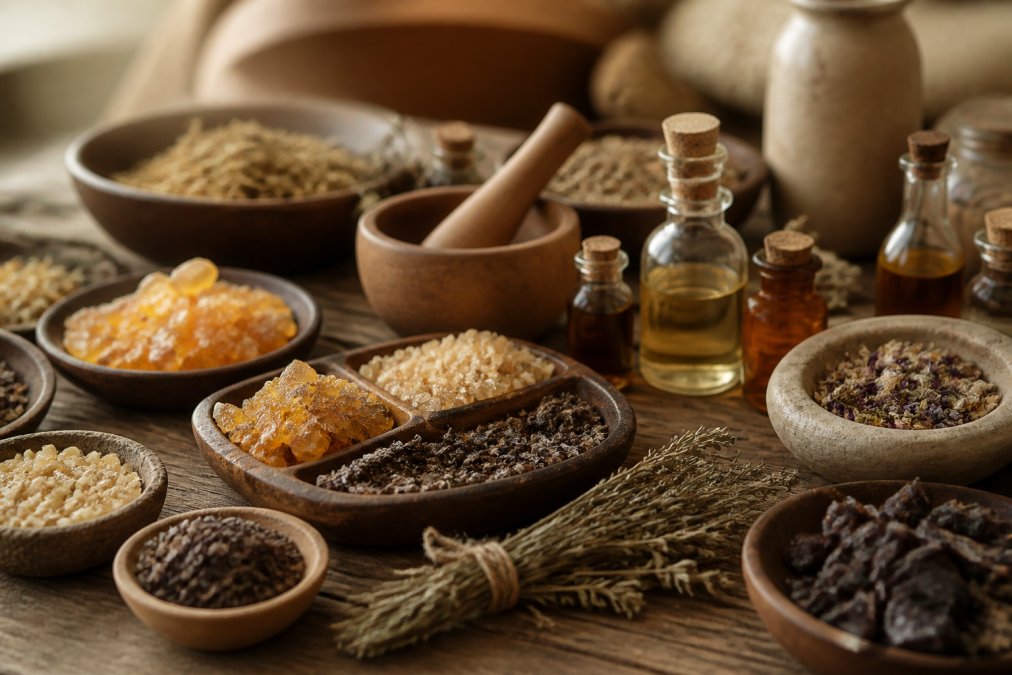
Biblical fragrances were built from resins, barks, and roots traded across long distances; nearly every ingredient in the scriptural record had to be imported. Each represented labor, distance, and cost, luxury goods with liturgical jobs.
| Scriptural Name | Likely Botanical Source | Native Range | Plant Part Used |
|---|---|---|---|
| Frankincense | Boswellia sacra and related Boswellia species | Southern Arabian Peninsula, Horn of Africa | Dried resin from tapped bark |
| Myrrh | Commiphora myrrha and related Commiphora species | Horn of Africa, southern Arabia | Dried resin from tapped bark |
| Stacte | Often identified with Commiphora resin or storax (Styrax officinalis) | Eastern Mediterranean, Arabia | Resin or gum |
| Galbanum | Ferula gummosa (syn. F. galbaniflua) | Persia, western Asia | Resin from root and stem |
| Onycha | Uncertain; commonly linked to a mollusk operculum or to labdanum (Cistus species) | Red Sea, Mediterranean | Shell operculum or resin |
| Cinnamon | Cinnamomum verum (true cinnamon) | Sri Lanka, South Asia | Inner bark |
| Cassia | Cinnamomum cassia | China, Southeast Asia | Bark |
| Calamus | Acorus calamus | South Asia, naturalized in wetlands | Rhizome (root) |
| Spikenard | Nardostachys jatamansi | Himalayan highlands | Rhizome and root oil |
| Saffron | Crocus sativus | Persia, Mediterranean | Dried flower stigmas |
| Aloes (NT) | Possibly Aquilaria species (agarwood) or Aloe | South and Southeast Asia | Resinous heartwood or leaf |
Frankincense and Myrrh: Significance and Symbolism
Frankincense and myrrh are dried tree resins, tapped from related trees that grow in arid regions south of ancient Israel. Both were harvested by cutting the bark and collecting the hardened sap.
Spikenard, Cinnamon, and Cassia
Spikenard is the outlier: a fragrant rhizome oil from Nardostachys jatamansi, which grows at high altitude in the Himalayas, not a resin. That distance explains its extraordinary price, since it traveled further than almost any other biblical aromatic to reach the Levant. In the gospels, a woman pours a jar of pure spikenard over Jesus, and onlookers object at the waste.
Why the Botany Matters
Knowing the species changes how you read the text. A formula calling for resin from a tree in one arid region depends on long-distance trade, political stability, and specialized harvesters; a Himalayan rhizome depends on mountain trade networks spanning thousands of miles. The ingredients were not chosen for exoticism. They were chosen because they worked, and they worked because of what those specific plants produce.
How Biblical Oils and Their Meanings Shaped Anointing
Anointing oil was the ceremonial act of pouring or smearing fragrant oil onto a person or object to set it apart. The fragrance was the smellable evidence that something had changed status.
- Priests were anointed to mark sacred office
- Kings were anointed to mark legitimate authority
- The sick were anointed as an act of care and hope
- The dead were prepared with myrrh and spices
Preparing Holy Anointing Oil and Incense
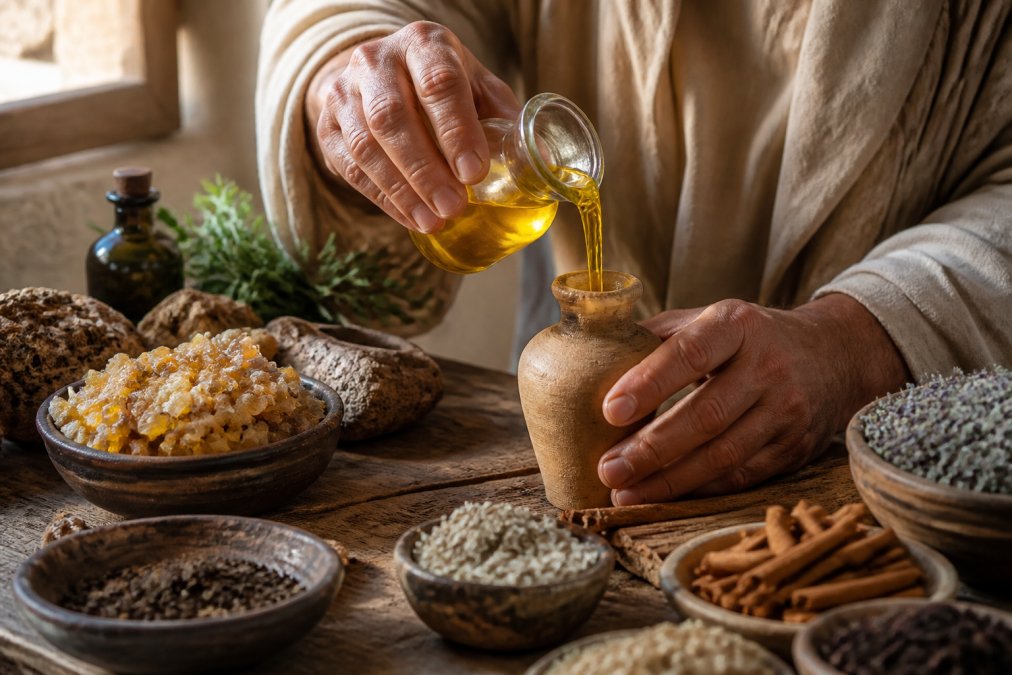
The recipe for holy anointing oil appears in Exodus: myrrh, cinnamon, calamus, and cassia blended into olive oil. The incense formula in the same book lists stacte, onycha, galbanum, and frankincense in equal parts. Both were compounded by a perfumer, a named trade, not improvised by a priest.
Extraction Methods: Distillation, Maceration, and Resin
Ancient perfumers had no solvents and no steam distillation as we know it. Their techniques each carried trade-offs in yield, cost, and scent character.
-
Resin collection: cut the bark, wait for the tree to exude sap, then scrape the hardened resin. This is how frankincense and myrrh reached the temple. The yield is low and seasonal, which is one reason these resins were expensive; a single Boswellia tree might produce only a few pounds of usable resin per year under traditional tapping.
-
Maceration (hot and cold): steep aromatic materials in oil or fat until the oil absorbs the scent, then strain. Cold maceration is slow, often taking weeks, and produces a delicate, true-to-source scent; hot maceration is faster but risks degrading fragile compounds. For anointing oil, cold maceration in olive oil was standard because the oil itself was part of the ritual and had to remain pure.
-
Enfleurage: press or layer delicate materials against a fat base, usually animal fat, so the fat absorbs the volatile oils. Most associated with flowers, it is the ancestor of modern enfleurage still used in a few high-end perfumeries. It is labor-intensive and low-yield, reserved for the most precious materials.
-
Expression and infusion: press or steep softer materials like saffron and spikenard root directly into a carrier. Saffron gives up its color and scent readily in warm oil, which is why it appears in both culinary and perfumery traditions.
The Perfumer's Trade
The Hebrew text uses a specific term for the perfumer, implying a trained specialist rather than a general craftsman. The same term appears with the incense formula, suggesting the trade was recognized and regulated. A perfumer needed access to imported raw materials, knowledge of which carriers worked with which aromatics, and the patience to run multi-week macerations. The text treats that skill set as specialized.
What Modern Reconstructions Get Wrong
A common pattern in modern attempts to recreate biblical scents is to lean on steam-distilled essential oils, which did not exist in the ancient world, producing a fragrance that smells cleaner and sharper than the original. A more faithful approach uses oil macerations of the same resins and barks, accepts a heavier, more resinous character, and lets the scent develop slowly on the skin.
Perfume as a Symbol of Honor and Hospitality
In the biblical world, fragrance was a social contract. Offering perfumed oil to a guest signaled respect; withholding it signaled insult. When a host failed to provide oil for a guest's head and feet, the omission was remembered.
The Spiritual Fragrance of Christ
The New Testament turns the physical vocabulary of scent into metaphor. Paul writes of believers as the "fragrance of Christ," a scent that reads as life to some and death to others. The image borrows from the temple: smoke that rises, invisible but unmistakable, carrying meaning to anyone nearby.
Modern Faith-Inspired Perfumes Rooted in Ancient Scents
Modern faith-inspired perfumes translate this vocabulary into wearable form, and the best ones respect the source material's density rather than chasing a fresh, bright, contemporary profile. Frankincense and myrrh remain the anchors because they are the two most documented resins in scripture, and both are still available as high-quality raw materials.
| Ancient Material | Modern Role in Perfumery | Character |
|---|---|---|
| Frankincense | Base note, incense accord | Dry, resinous, slightly citrus |
| Myrrh | Base note, fixative | Warm, bitter, balsamic |
| Spikenard | Heart note | Earthy, musky, animalic |
| Cinnamon / Cassia | Heart note | Hot, sweet, spicy |
| Calamus | Heart note | Woody, slightly sweet |
| Saffron | Top note | Leathery, metallic, floral |
Frequently Asked Questions
What scents were used in the Bible?
The Bible names more than a dozen aromatic substances. Frankincense and myrrh appear most often, followed by spikenard, cinnamon, cassia, calamus, aloes, saffron, stacte, onycha, and galbanum. These came from tree resins, bark, roots, and flowers. Many were burned as holy incense in the temple or blended into anointing oil. Others, like spikenard, were poured directly on a person as an act of honor. Together they formed the core palette of biblical fragrances.
What is the spiritual significance of perfume in biblical times?
Perfume carried meaning beyond pleasant smell. Anointing with oil set apart priests, kings, and sacred objects. Incense rose as a sacrificial offering, a physical sign of prayer reaching God. Fragrant oil poured on a guest signaled honor and hospitality. In the Song of Solomon, fragrance becomes a metaphor for love and devotion. The spiritual fragrance of Christ, described by Paul, extends this idea: a life lived in faith spreads a recognizable, pleasing aroma.
How were biblical oils and perfumes prepared?
Ancient perfumers used methods like maceration and resin burning. Maceration steeped flowers, roots, or bark in olive oil for days or weeks, drawing out the scent. Resins like frankincense and myrrh were often burned directly on coals or ground into powder for holy incense. Exodus gives a precise recipe for anointing oil, blending olive oil with myrrh, cinnamon, calamus, and cassia.
How do ancient biblical scents influence modern faith-inspired perfumes?
Modern faith-inspired perfumes draw on the same resin, spice, and floral notes that defined biblical fragrances. Frankincense and myrrh appear in contemporary eau de parfum as warm, smoky base notes. Spikenard and saffron add earthy depth. Brands rooted in story and faith, like Ruth+Bo, build entire collections around these ancient ingredients, letting wearers connect personal identity with timeless narratives. The result is a fragrance that carries historical weight while working for everyday wear.